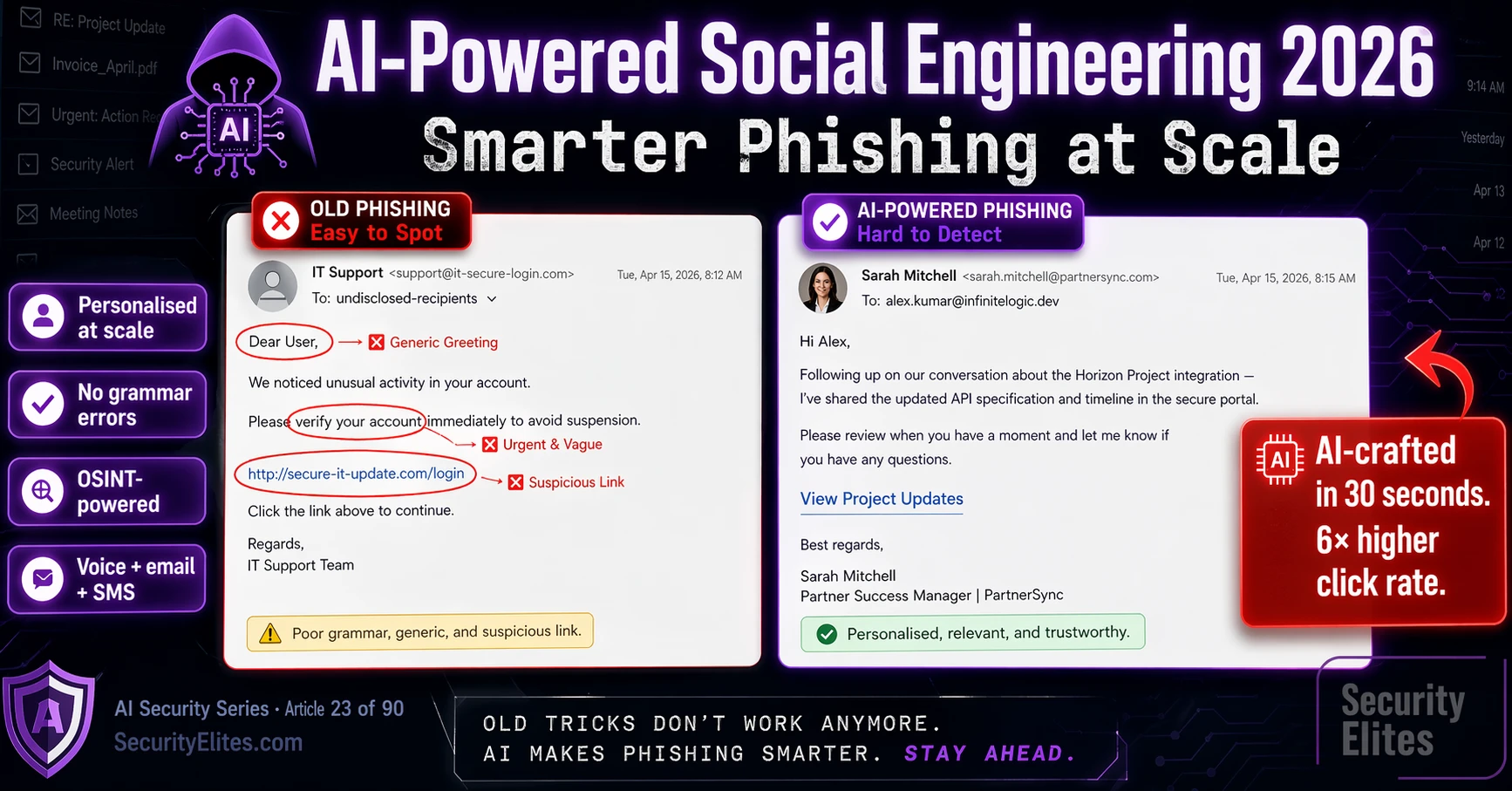
This article examines how generative AI has fundamentally transformed social engineering attacks by enabling attackers to create highly personalized, grammatically perfect phishing emails and voice attacks at massive scale within minutes. The author demonstrates through real testing that AI-assisted phishing achieves 34% click rates compared to 8% for generic templates, and argues that traditional security awareness training focused on detecting grammar errors and suspicious senders is now ineffective. The article provides a technical breakdown of the OSINT-to-LLM pipeline used in documented attacks, explains why existing defenses fail, and details process-level controls that remain reliable regardless of content quality.
- AI eliminates the effort-quality tradeoff in phishingTraditional spear phishing required hours of manual research per target but could only reach 20 personalized emails daily. LLM-assisted phishing generates thousands of personalized emails per day in seconds while maintaining native-quality language and contextual accuracy. An attacker with automation can now spend approximately 3 minutes per target to complete the entire OSINT-to-delivery pipeline, making mass personalization economically cheaper than generic phishing was historically.
- OSINT-to-LLM pipeline feeds real organizational contextThe documented attack pipeline automatically harvests information from LinkedIn profiles, company websites, news articles, GitHub repositories, and social media to build target context. This data feeds into LLM prompts that generate emails referencing the target's actual job title, real projects they're involved in, and specific colleagues by name. The article's side-by-side example shows how an AI-generated spear phishing email can reference the 'Phoenix project,' mention 'Mike' from the all-hands meeting, and invoke a legitimate 'Q2 security audit'—all from public sources—to achieve complete
- Grammar and generic greetings no longer signal phishingTraditional security awareness training emphasized checking for grammar errors and generic greetings like 'Dear Customer' as reliable indicators. AI-generated phishing eliminates both red flags, producing native-quality text in any major or minor language and using personalized greetings based on OSINT data. The article notes that an AI-generated email may have better grammar than a legitimate message from a non-native English speaker colleague, rendering the grammar-checking heuristic unreliable by 2026.
- AI vishing extends to real-time script assistance and voice cloningBeyond email, AI assists phone-based social engineering through LLM-generated scripts optimized for handling objections and real-time earpiece assistance for callers facing unexpected questions. The 2024 Hong Kong deepfake video conference fraud represents the highest-profile documented case: employees participated in a video call featuring deepfake versions of senior executives including the CFO, and despite initial doubts, the visual and audio quality was sufficient to override skepticism and authorize approximately $25 million in wire transfers.
- Email authentication remains reliable against spoofingDMARC, SPF, and DKIM email authentication checks remain effective defenses because they verify infrastructure rather than content quality—attackers cannot fake these headers for legitimate domains. However, the article notes that most organizations have DMARC configured in monitoring-only mode (p=none) rather than enforcement mode (p=reject or p=quarantine), meaning spoofed emails from executive addresses still reach recipients despite this control being deployable.
- Out-of-band verification stops all variants regardless of qualityThe article argues that the single most reliable defense operates at the process level: verifying any high-risk request through a pre-established independent channel before acting. For financial requests, this means calling the requester back on a number from the company directory rather than using contact information in the suspicious communication, or using internal messaging systems to confirm. This defense works regardless of email content quality because it removes the reliance on the recipient correctly identifying social engineering.
- Traditional detection training failed even security professionalsThe article recounts a simulation where a security awareness trainer who had personally conducted the company's phishing training for three years clicked on an AI-generated spear phishing email. The trainer's statement—'I would have caught the old ones'—illustrates that employees were not naive but were correctly applying the training criteria they received; the AI-generated email passed every criterion they were taught to check. The problem was with the training methodology, not employee capability.
- Security awareness training must shift to behavior changeThe article argues that security awareness training in 2026 must reframe from 'spot the suspicious email' to 'verify before acting.' The updated message should be that regardless of how convincing a request appears, unusual requests outside normal workflow require verification through an established channel. The article emphasizes that this represents a fundamental reframe toward process controls and systematic protections rather than individual content inspection abilities.
Bottom line: AI-generated social engineering attacks are now highly effective at scale because they eliminate the traditional effort-quality tradeoff, making traditional training focused on grammar errors and suspicious indicators ineffective even against security professionals. Organizations must shift defenses from content inspection to process-level controls—out-of-band verification for high-risk actions, financial approval chains, and DMARC enforcement—that protect regardless of email quality, paired wit
Last year I ran a phishing simulation for a client — AI-generated emails personalised from LinkedIn data, referencing real project names I pulled from their press releases. The click rate was 34%. The same campaign using generic templates: 8%. That gap is what AI does to social engineering economics.
What I want to give you here is the full technical picture of how these attacks are built, why traditional defences fail against them, and the specific process-level controls that actually work. Because the answer isn’t better spam filtering. The answer is understanding that AI eliminated the effort barrier, which means your defences need to shift from content inspection to process verification.
Has your organisation been targeted by AI-generated phishing or vishing?
🎯 What You’ll Learn
⏱️ 30 min read · 3 exercises
📋 AI-Powered Social Engineering 2026 – Contents
Three Ways AI Improves Phishing
Scale without quality loss. Traditional spear phishing required hours of manual research and writing per target. LLM-assisted phishing generates personalised emails in seconds. An attacker who could previously send 20 personalised spear phishing emails per day can now send thousands while maintaining the same quality. The effort economics have inverted: mass personalised phishing is now cheaper per-target than generic phishing was.
Language quality in any target language. Generic phishing campaigns were historically limited by language quality — campaigns targeting non-English speakers often betrayed their non-native origin through grammar errors. LLMs produce native-quality text in all major languages and many minor ones. The grammar-checking heuristic that security awareness training emphasised is now unreliable: AI-generated phishing may have better grammar than a legitimate email from a non-native English speaker colleague.
Contextual personalisation from OSINT. The most sophisticated AI-assisted phishing chains OSINT gathering with LLM content generation. LinkedIn profile data, company website content, recent news about the organisation, GitHub repositories, and social media activity feed into a prompt that generates an email referencing real context: the target’s actual job title, a real project they’re involved in, a real colleague they work with. This contextual accuracy dramatically increases click and response rates.
Subject: Urgent: Account Suspended
Dear Customer,
Your account have been suspend. Please verify your informations immediately to avoid permanent closure.
Click here to verify: [suspicious-link.ru]
Subject: Q2 Security Audit — Action Required
Hi Sarah,
Following up on the Phoenix project security review that Mike mentioned in last week’s all-hands. IT needs you to verify your MFA settings by Friday before the audit. Takes 2 minutes:
[legitimate-looking link]
Thanks, James
The OSINT-to-LLM Spear Phishing Pipeline
Documented AI-assisted spear phishing operations follow a consistent pipeline: OSINT gathering, LLM content generation, delivery infrastructure, and payload. The OSINT phase uses tools like theHarvester, LinkedIn scraping, and company website analysis to build a profile of the target and their organisational context. This takes seconds with automated tooling for most targets.
The LLM generation phase takes the gathered context and generates email content with a specific objective: credential phishing, wire transfer request, malware attachment download, or callback to a vishing number. The prompt specifies the target’s name, role, organisation, and contextual references; the LLM generates contextually appropriate content in the target’s language with the specified goal. Multiple variants can be generated and tested for quality in minutes.
Delivery infrastructure — spoofed domains with valid email authentication, lookalike domains, or compromised legitimate accounts — provides the final layer of plausibility. The convergence of AI-quality content with legitimate-appearing infrastructure removes most of the traditional detection signals that email security training relied on.
AI Vishing and Deepfake Voice Fraud
AI vishing extends the quality improvements of LLM-generated content to phone-based social engineering. The simplest form is LLM-generated scripts that anticipate common scepticism responses and provide prepared countermoves — a call centre script optimised specifically for the social engineering goal. More sophisticated attacks use real-time LLM assistance, where the caller receives suggested responses to unexpected questions in an earpiece, enabling them to handle unusual objections convincingly.
The highest-profile documented case of AI-assisted voice fraud is the 2024 Hong Kong deepfake video conference incident — employees of a multinational corporation were invited to a video conference that featured deepfake versions of multiple senior executives, including the CFO. The participants, believing they were on a legitimate internal call, were instructed to authorise wire transfers totalling approximately $25 million. The attack succeeded despite the participants having doubts — the visual and audio quality of the deepfakes was sufficient to override scepticism during the call.
⏱️ 15 minutes · Browser only
Search: “Hong Kong deepfake video conference fraud 25 million 2024”
What was the attack sequence?
How did attackers convince participants despite initial doubts?
What would have stopped this attack?
Step 2: Find AI-assisted phishing research
Search: “AI generated phishing email effectiveness research 2024”
Search: “LLM phishing email click rate study”
What improvement in click-through rates do studies show for
AI-generated vs generic phishing?
Step 3: Research AI vishing documented cases
Search: “AI vishing attack case study 2024 financial”
What phone-based AI social engineering has been documented?
What sectors are most targeted?
Step 4: Explore AI phishing simulation tools (for authorised testing)
Search: “AI phishing simulation platform 2024 2025”
What do commercial phishing simulation platforms offer for AI-generated content?
How do organisations use these for security awareness testing?
Step 5: Review FBI/IC3 social engineering statistics
Go to: ic3.gov — look at Business Email Compromise statistics
How much financial loss does social engineering cause annually?
What percentage of attacks now show AI-assisted characteristics?
📸 Screenshot one documented case summary. Share in #ai-security on Discord.
Why Traditional Detection Fails
Security awareness training built around grammar checking, generic greeting detection, and suspicious sender identification was effective when phishing required manual effort — attackers couldn’t invest hours per target while also maintaining quality across all the surface-level indicators training covered. AI generation eliminates this tradeoff. An attacker using LLM-generated content gets personalisation, quality language, contextual accuracy, and native grammar simultaneously, at scale. Every indicator traditional training taught users to check for can be correct in an AI-generated attack.
Email security products face the same challenge. Signature-based detection misses novel AI-generated content with no prior pattern match. Sender reputation systems are bypassed by newly registered lookalike domains that have not yet accumulated negative reputation. Link analysis catches known malicious URLs but cannot evaluate the destination of a newly registered phishing site. The arms race has shifted: the detection gap that used to be exploited at low scale because of attacker effort limitations is now being exploited at high scale because AI has removed those limitations.
Process-Level Defences That Actually Work
The defences that remain effective against AI-quality social engineering operate at the process level rather than the content evaluation level. Out-of-band verification for all high-risk actions is the primary defence: any request to transfer money, change credentials, grant access, or provide sensitive information received via email or phone should be verified through a separate, pre-established channel before action is taken. Call the requester back on a known number — not a number provided in the suspicious communication. Use an internal messaging system to verify email requests. The principle is: if you didn’t initiate the interaction, verify before acting, regardless of how convincing the request appears.
Process controls for financial actions — requiring dual authorisation for wire transfers, transaction limits that require management approval, and callback verification procedures for large transfers — provide systemic protection that does not depend on any individual correctly identifying social engineering. These controls were effective against traditional BEC attacks and remain effective against AI-assisted ones because they operate on the action, not the communication channel that requested it.
Updating Security Awareness Training
Security awareness training in 2026 needs a fundamental reframe: shift from “spot the suspicious email” to “verify before acting.” The content-inspection approach (check grammar, check sender, check link) worked in the era of low-quality phishing and should not be abandoned — technical indicators still provide value. But content inspection as the primary defence against social engineering is no longer sufficient. The training message needs to be: regardless of how convincing a request appears, any unusual request that asks for actions outside your normal workflow requires verification through an established channel before you act.
⏱️ 15 minutes · No tools required · For defender education only
This exercise is for security professionals building awareness programmes.
Scenario: You’re red teaming your own organisation’s
social engineering resilience. Design the attack to test your controls:
TARGET PROFILE (create a hypothetical)
Department: Finance (high-value target for BEC)
Role: Accounts Payable Coordinator
LinkedIn: Public profile, employer visible, mentions current projects
Recent company news: Q1 results published, mentions CFO by name
1. OSINT COLLECTION
What publicly available information about this person and
their organisation would you gather?
Where specifically would you find it?
How long would this take with automated OSINT tools?
2. PRETEXT DESIGN
What legitimate-sounding scenario would you construct?
Who would you impersonate? (based on OSINT data)
What action would you request?
Why is this action plausible for this person and role?
3. DETECTION FAILURE POINTS
Which traditional phishing detection indicators
would NOT catch this attack?
What would an email filter NOT flag?
4. WHAT WOULD STOP THIS ATTACK
For each element of the attack you designed:
What process control or technical control prevents it?
Which control is most reliable regardless of attacker sophistication?
5. TRAINING IMPROVEMENT
Based on your attack design:
What should your security awareness training teach
THIS specific person that would stop the attack?
📸 Share your attack design and the controls that would stop it in #ai-security on Discord.
⏱️ 15 minutes · Browser only
Search: “AI email security phishing detection 2024 2025”
What approaches do current products use?
Can any reliably detect AI-generated phishing content?
Step 2: Find SANS and KnowBe4 guidance on AI phishing
Search: “SANS social engineering AI phishing awareness 2024”
Search: “KnowBe4 AI generated phishing training 2024”
How are leading security awareness platforms updating their content?
What new training approaches do they recommend?
Step 3: Review the 2024 IC3 Business Email Compromise report
Go to: ic3.gov/Media/PDF/AnnualReport/2023_IC3Report.pdf
What is the total financial loss from BEC in the most recent report?
What sectors are most targeted?
Step 4: Research DMARC adoption rates
Search: “DMARC adoption rate enterprise 2024 2025”
What percentage of domains have DMARC configured?
What percentage have it set to reject (rather than report only)?
Step 5: Design a 2026-updated security awareness training module
For a 20-minute security awareness training session,
outline the content that addresses AI-powered social engineering:
– What old content can be removed or reduced?
– What new content should be added?
– What is the single most important behaviour change to reinforce?
📸 Screenshot your updated security awareness training outline. Post in #ai-security on Discord. Tag #aiphishing2026
🧠 QUICK CHECK — AI Social Engineering
📋 AI Social Engineering Defence Quick Reference 2026
🏆 Mark as Read — AI-Powered Social Engineering 2026
Article covers AI chatbot data exfiltration via prompt injection — how attackers use injected instructions to cause AI assistants to leak user data through covert channels.
❓ Frequently Asked Questions — AI Social Engineering 2026
How is AI making phishing more dangerous?
What OSINT does AI use for spear phishing?
What is AI vishing?
How do you detect AI-generated phishing?
What defences work against AI social engineering?
Is AI-assisted social engineering illegal?
AI Jailbreaking Research
Chatbot Data Exfiltration
📚 Further Reading
- How Hackers Bypass 2FA in 2026 — After social engineering harvests credentials, 2FA bypass is the next step — understanding both attack phases provides complete defence context.
- AI Voice Cloning Authentication Bypass — Technical deep-dive on voice cloning — the technology underlying AI vishing and deepfake phone/video fraud.
- AI Security Series Hub — Full 90-day AI security curriculum.
- FBI IC3 Internet Crime Report 2023 — BEC and social engineering financial loss statistics — the data that contextualises why AI improvement of these attacks is a critical threat.
- CISA — Phishing Guidance — CISA’s current phishing defence guidance including email authentication requirements and incident reporting procedures.