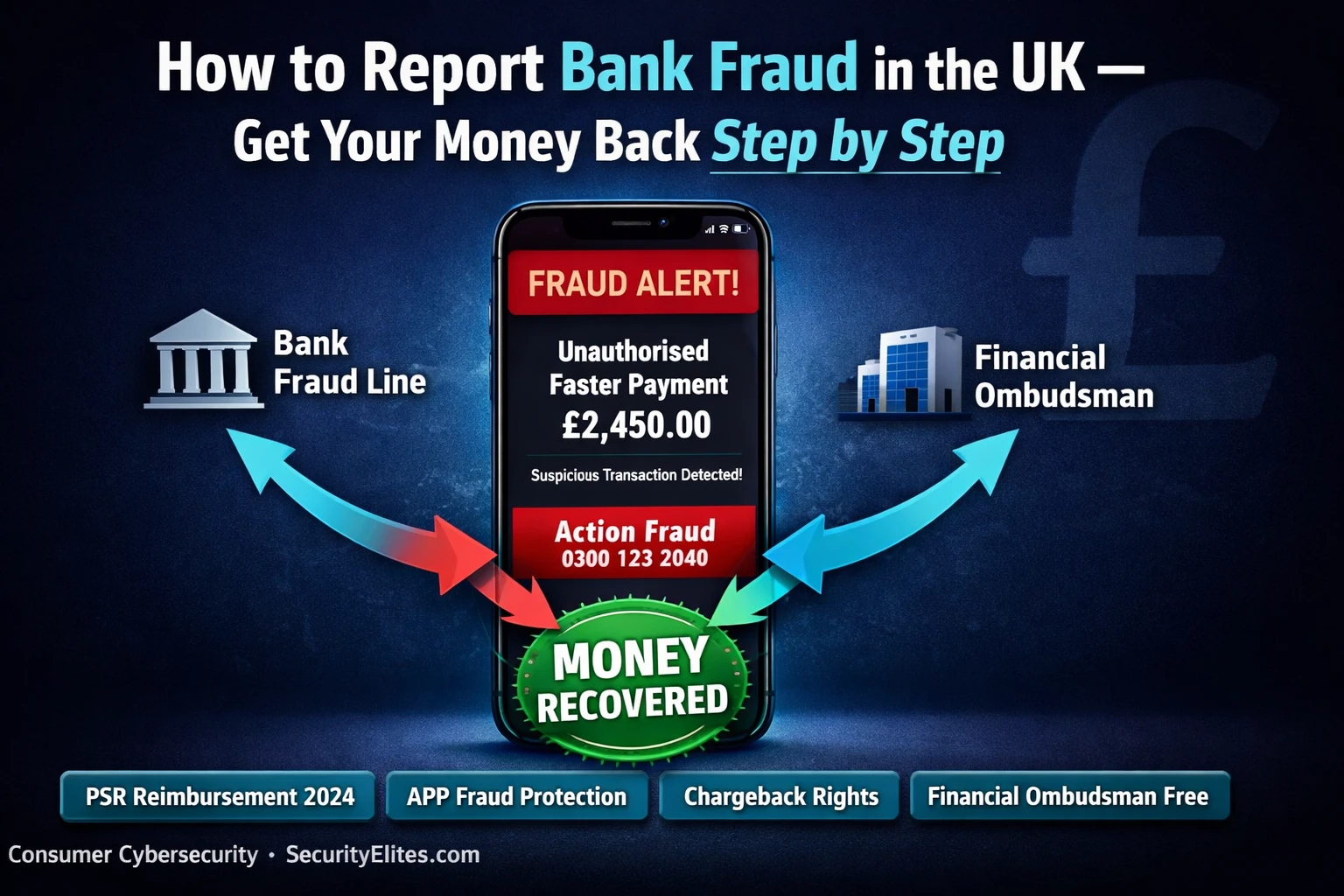
This article provides a comprehensive step-by-step guide for UK bank and credit card fraud victims to recover their money through formal complaint processes and regulatory escalation. It explains that significant changes to UK fraud protection law took effect in October 2024, when the Payment Systems Regulator mandated that banks reimburse victims of Authorised Push Payment (APP) fraud up to £85,000. The guide matters because most fraud victims do not know these rights exist or how to claim them, and the article argues that citing the correct legal frameworks and following the proper escalation sequence dramatically improves recovery outcomes.
- PSR mandatory reimbursement for APP fraudSince October 2024, UK banks must mandatorily reimburse victims of Authorised Push Payment fraud up to £85,000 per claim—a legal requirement, not voluntary policy. APP fraud covers situations where a victim was deceived into sending money via bank transfer to a fraudster, including fake invoice fraud, conveyancing fraud (impersonating solicitors), safe account fraud (bank impersonation), romance scams, investment scams, and purchase scams. The rule applies to Faster Payments and CHAPS transfers to UK accounts only, not international SWIFT transfers or cheques.
- Section 75 Consumer Credit Act protectionSection 75 of the Consumer Credit Act 1974 makes credit card companies jointly liable for fraud or misrepresentation on transactions between £100 and £30,000—a statutory right that covers the full transaction amount, not just the card payment amount. For example, paying a £500 credit card deposit for an £8,000 service that never materializes allows the victim to claim the full £8,000, not just £500. This is the primary protection mechanism for credit card fraud above £100.
- Immediate action sequence within first hourThe article emphasizes that the first 60 minutes are critical: call the bank's 24/7 fraud line (number on card back) to open a formal case and attempt to recall faster payments before processing, report to Action Fraud at 0300 123 2040 or online to obtain an NFRC crime reference number, and send a formal written complaint. These actions trigger legally mandated bank responses (acknowledgement within 5 business days, final response within 8 weeks under FCA rules) and provide documentation that significantly strengthens any subsequent escalation.
- Action Fraud reporting creates official crime recordAction Fraud (0300 123 2040, or actionfraud.police.uk 24/7 online), operated by City of London Police and the National Fraud Intelligence Bureau, generates an official crime record and a National Fraud and Cybercrime Reporting Centre (NFRC) crime reference number. This reference number is essential documentation that both banks and the Financial Ombudsman reference during investigations and significantly strengthens dispute claims. Reporting must be done after calling the bank but as early as possible.
- Financial Ombudsman Service escalation pathThe Financial Ombudsman Service (financial-ombudsman.org.uk, 0800 023 4567) is a free, independent, legally binding dispute resolution body that can order banks to refund the full fraud amount, pay 8% simple interest from the date of fraud, and pay compensation for distress and inconvenience (typically £100–£500). A victim can escalate to FOS if the bank refuses the claim or fails to respond within 8 weeks of receiving a formal written complaint. The 6-month filing deadline after the bank's final response letter is strict, and missing it may prevent FOS from accepting the case.
- Chargeback for debit cards under £100Chargeback is a Visa, Mastercard, and Maestro transaction reversal mechanism available for both debit and credit cards with no minimum amount and up to 120 days from transaction date or discovery of fraud. Unlike Section 75, chargeback is a voluntary card industry scheme, not a statutory right, but UK banks are expected to pursue valid chargebacks on behalf of customers. Chargeback is the appropriate mechanism for debit card fraud of any amount and credit card fraud under £100 (above £100 use Section 75).
- Safe account fraud as most damaging social engineeringSafe account fraud (also called 'safe account scam') is identified as the most common large-sum fraud targeting UK residents over 60, where a caller impersonating bank staff convinces the victim their account is compromised and they must transfer money to a fraudster-controlled 'safe account' for protection. Modern variants use AI voice cloning to sound exactly like bank staff, and caller ID spoofing displays the victim's real bank number. The article emphasizes this fraud type is now covered by PSR mandatory reimbursement if payment was via Faster Payments, provided the victim was clearly dec
- Formal written complaint triggers regulated timelineA phone call to the bank opens a case, but a formal written complaint triggers FCA-regulated mandatory timelines: the bank must acknowledge within 5 business days and issue a final response within 8 weeks. The article provides a template emphasizing specific legal citations (PSR mandatory reimbursement October 2024, Section 75 CCA 1974, or chargeback as applicable), Action Fraud NFRC reference number, and bank fraud case reference. Sending via both email to complaints department and Royal Mail recorded post creates documentary evidence and is essential for any FOS escalation.
Bottom line: UK fraud victims who follow the correct escalation sequence—calling their bank immediately, reporting to Action Fraud, submitting a formal written complaint citing the specific legal framework (PSR APP fraud reimbursement, Section 75, or chargeback), and escalating to the free Financial Ombudsman Service if refused—have legally enforceable recovery rights that banks often do not voluntarily honor. The single most underutilized tool is the Financial Ombudsman, which has no cost, makes legally bin
Have you or someone you know experienced bank or card fraud in the UK?
Here’s what most UK fraud victims don’t know: the rules changed in October 2024. The Payment Systems Regulator introduced mandatory reimbursement for Authorised Push Payment fraud. That means if you were tricked into sending money, your bank must now pay you back up to £85,000 — even if the bank wasn’t technically at fault. This is law. Not policy. Not goodwill.
Add to that Section 75 of the Consumer Credit Act, chargeback rights, and the Financial Ombudsman — and the UK consumer protection framework is one of the strongest in the world. The problem is almost no one knows how to use it. I’m going to walk you through every step, every number, and every escalation path in the right order.
🎯 What You’ll Know After This
25 min read. Bookmark this now.
How to Report Bank Fraud in the UK 2026 – Complete Recovery Guide Contents
- IMMEDIATE — Call Your Bank Fraud Line
- Report to Action Fraud (0300 123 2040)
- The October 2024 PSR Rule — APP Fraud Rights
- Section 75 Consumer Credit Act
- Chargeback — Debit Cards and Sub-£100 Transactions
- Formal Written Complaint to Your Bank
- Financial Ombudsman Service
- Specific Steps by Fraud Type
- Full Escalation Ladder
- Documentation Checklist
STEP 1 — Call Your Bank Fraud Line Immediately
Call the number on the back of your card right now.
Every major UK bank has a 24/7 fraud line. Don’t call the main branch — ask directly for the fraud or disputes team. Your bank can attempt to recall a Faster Payment in the short window before it is processed further, freeze your account to prevent additional transactions, and open a formal fraud case that starts the clock on their legal obligations to you.
STEP 2 — Report to Action Fraud
0300 123 2040 — Action Fraud — Report now.
Action Fraud is the UK’s national fraud reporting centre, operated by the City of London Police and the National Fraud Intelligence Bureau (NFIB). Reporting creates an official crime record and gives you a National Fraud and Cybercrime Reporting Centre (NFRC) crime reference number — a document your bank and the Financial Ombudsman can reference. This reference number significantly strengthens any subsequent dispute with your bank.
The October 2024 PSR Rule — Your APP Fraud Rights
Since 7 October 2024, the Payment Systems Regulator requires all UK banks participating in Faster Payments to mandatorily reimburse victims of Authorised Push Payment (APP) fraud up to £85,000 per claim. This is the most significant improvement in UK bank fraud protection in decades.
What is APP fraud? APP fraud is where you are manipulated into authorising a payment to a fraudster — you sent the money, but you were deceived. This covers: fake invoice fraud, conveyancing fraud (impersonating your solicitor), bank impersonation (“safe account fraud”), romance scams, investment scams, purchase scams (paying for goods that never arrive), and CEO or mandate fraud.
Section 75 Consumer Credit Act — Strongest Credit Card Protection
Section 75 of the Consumer Credit Act 1974 makes your credit card company jointly liable for fraud or misrepresentation — on transactions between £100 and £30,000. Statutory right. Not bank policy. Not goodwill. If a fraudster charged your credit card, your card company must refund you.
15 minutes. Do this now — before fraud happens.
Label it: BANK FRAUD [Bank Name]
ACTION 2: Save Action Fraud: 0300 123 2040
Label it: ACTION FRAUD UK
ACTION 3: Save Financial Ombudsman: 0800 023 4567
Label it: FINANCIAL OMBUDSMAN UK
ACTION 4: Bookmark these official sites now:
actionfraud.police.uk
financial-ombudsman.org.uk
fca.org.uk/consumers/report-financial-scam
ACTION 5: Enable transaction alerts on ALL bank accounts
Bank app — Notifications — enable for every transaction
ACTION 6: Note your bank’s postal complaints address
On your statement or bank website — needed for formal complaint letter
ACTION 7: Check your credit card for Section 75 protection
Write down your credit card issuer’s disputes email
ACTION 8: Enable two-step verification on your banking apps
The single most effective fraud prevention step available now
ACTION 9: Consider CIFAS Protective Registration
cifas.org.uk — costs £30 — puts a flag on your name so
lenders do extra checks before granting new credit
Worth it if you have already been a fraud victim
The goal: if fraud happens at 11pm on a Sunday, you can call
the fraud line, start an Action Fraud report, and send a
written complaint — all within 20 minutes, without searching online.
Share these numbers with elderly family members. “Safe account fraud” — where a caller pretends to be from your bank — is the most common large-sum fraud targeting older people in the UK. Tag #BankFraudUK
Chargeback — Debit Cards and Transactions Under £100
Chargeback is a card network mechanism operated by Visa, Mastercard, and Maestro that allows your bank to reverse a card transaction. Unlike Section 75, chargeback applies to both credit and debit cards with no minimum transaction value — making it the right route for debit card fraud and credit card fraud under £100.
Chargeback is a voluntary scheme, not a statutory right like Section 75. However, UK banks are expected to pursue chargebacks on your behalf. If your bank refuses to initiate a valid chargeback, that refusal can itself be escalated to the Financial Ombudsman.
STEP 4 — Raise a Formal Written Complaint with Your Bank
A phone call opens your case. A written formal complaint triggers your bank’s regulated complaints process — which has legally mandated timelines under FCA rules. The bank must acknowledge your complaint within 5 business days and provide a final response within 8 weeks. If they do not, or if their response is unsatisfactory, you can go straight to the Financial Ombudsman.
15 minutes. Share with elderly family members in particular.
Caller claims to be from your bank’s fraud team. They say your account
has been compromised. You need to move money to a “safe account” they will
set up for you. The caller ID shows as your bank’s real number (spoofed).
ANALYSIS: This is the most common large-sum fraud in the UK — known as
“safe account fraud.” The safe account belongs to the fraudster. No bank
ever asks you to move money to protect it.
WHAT TO DO: Hang up. Call your bank on the number from your card.
SCENARIO 2 — Fake Solicitor or Conveyancing Fraud
You are buying a house. An email arrives from what appears to be your
solicitor with updated bank details for the completion payment.
ANALYSIS: Fraudsters intercept or spoof solicitor emails and substitute
their own account details. Even one digit different means the money goes
to the fraudster. Conveyancing fraud costs UK victims millions every year.
WHAT TO DO: Always call your solicitor on a number you have independently
to verbally confirm bank details before any property payment. Never rely
on details provided by email alone.
SCENARIO 3 — Purchase Scam via Marketplace
You buy something on Facebook Marketplace or Gumtree. The seller asks
for payment via bank transfer. The item never arrives.
ANALYSIS: Bank transfer gives you minimal protection compared to credit card.
For items over £100, a credit card gives you Section 75 protection.
WHAT TO DO: Always pay for high-value items by credit card where possible.
SCENARIO 4 — HMRC or Police Impersonation
An automated call: “This is HMRC. You have an arrest warrant. Press 1.”
ANALYSIS: HMRC and the police never threaten arrest over the phone.
This creates panic so you act without thinking.
WHAT TO DO: Hang up. HMRC correspondence is always by post first.
FOR EACH SCENARIO: What is the one action that would have stopped the fraud?
Share Scenario 1 with your parents. Safe account fraud is the most common large-sum fraud targeting people over 60 in the UK. Tag #BankFraudUK
STEP 5 — Escalate to the Financial Ombudsman Service
The Financial Ombudsman Service is the most powerful tool you have after the bank complaint stage. Completely free. Independent of your bank. Its decisions are legally binding on the bank — they have to comply. The FOS can order your bank to refund the disputed amount, pay interest, and pay compensation. Banks must comply with FOS decisions.
| When | Action | Get Reference |
| Immediately | Call bank fraud line, block card | Bank case number |
| Same day | Report to Action Fraud | NFRC crime ref. |
| Within 2–3 days | Formal written complaint to bank | Royal Mail tracking |
| Day 5 | Bank must acknowledge complaint | Ack. letter |
| Day 56 (8 weeks) | Bank must issue final response | Final response letter |
| Day 57 to 6 months | If unsatisfied: FOS escalation | FOS case number |
Specific Steps by Fraud Type
Romance Scam or Investment Fraud: Both are covered by the PSR mandatory reimbursement if you transferred money via Faster Payments. Also report to the FCA’s ScamSmart service at fca.org.uk/scamsmart. If the firm was impersonating a real FCA-regulated firm (known as a clone firm), report specifically to the FCA at 0800 111 6768.
Conveyancing or Property Fraud: Property fraud is one of the most damaging forms of social engineering fraud — fraudsters intercept or spoof legitimate solicitor emails. The PSR reimbursement applies if payment was via Faster Payments. Also contact your solicitor immediately — they may have professional indemnity insurance. Report to the Solicitors Regulation Authority (SRA) at sra.org.uk if the fraudster was impersonating a solicitor.
Online Purchase Fraud: Credit card over £100 — Section 75 applies. Debit card — request chargeback immediately. Bank transfer — PSR reimbursement if you were deceived. Report to Action Fraud and to the platform (eBay, Facebook, Gumtree) where the fraudster was active.
SIM Swap Fraud: SIM swap fraud lets attackers intercept your bank OTPs. Contact your mobile provider first on another phone — report the fraudulent SIM swap and recover your number. Then call your bank. SIM swap is a third-party technical fraud — you didn’t authorise the transactions. Under the PSR framework this should result in full reimbursement.
15 minutes. Browser only.
actionfraud.police.uk
financial-ombudsman.org.uk
fca.org.uk/consumers/report-financial-scam
psr.org.uk
cifas.org.uk
Step 2: Read the actual PSR reimbursement policy
Go to psr.org.uk
Search: APP fraud reimbursement
Read the consumer-facing guidance.
What exactly qualifies? What are the gross negligence exclusions?
Step 3: Check your bank’s APP fraud policy
Search: [Your Bank] APP fraud reimbursement 2024
Verify your bank is participating in the PSR mandatory scheme.
Step 4: Explore MoneyHelper for additional free guidance
Go to moneyhelper.org.uk/en/money-troubles/scams
This is the UK government’s free financial guidance service.
Note their free telephone helpline number: 0800 138 7777
Step 5: Find your bank’s formal complaints procedure
Go to your bank’s website and find “How to complain”
Note: their complaints email address and postal address
This is the address for your certified complaint letter.
Screenshot the PSR reimbursement consumer page. Tag #BankFraudUK on social media.
Full Escalation Ladder — When Your Bank Will Not Help
UK Bank Fraud Escalation — Level by Level
Documentation Checklist — Keep Everything
Evidence You Must Preserve
QUICK CHECK — UK Bank Fraud Recovery
Bookmark This Page — Share It With Family
You now understand the PSR rules, Section 75, chargeback, the Financial Ombudsman, and the full escalation path — most UK residents know none of this. Share particularly with elderly family members. Safe account fraud is the most common large-sum fraud targeting older people in the UK and the PSR rules mean there’s now mandatory reimbursement protection most victims are unaware of.
Frequently Asked Questions — Bank Fraud UK 2026
What is APP fraud and am I protected?
What is Section 75 and how does it protect me?
What is chargeback and when should I use it?
What is Action Fraud and do I need to report to them?
What is the Financial Ombudsman Service?
Does the PSR reimbursement rule cover all bank transfers?
Bank Fraud Guide — USA
Bank Fraud Guide — India
Further Reading and Official Resources
- Action Fraud — National Fraud Reporting Centre — Report all UK fraud here to receive your NFRC crime reference number. Available 24/7 online. Essential step after calling your bank.
- Financial Ombudsman Service — Free escalation if your bank refuses your claim or doesn’t respond in 8 weeks. Legally binding decisions. File within 6 months of the bank’s final response letter.
- FCA — Report a Financial Scam — Report clone investment firms and regulated firm impersonation to the Financial Conduct Authority. Also operates the 0800 111 6768 ScamSmart line.
- How to Report Bank Fraud in India — Complete step-by-step guide for Indian customers covering 1930 helpline, RBI zero liability rules, cybercrime.gov.in, and RBI Ombudsman escalation.
- How to Report Bank Fraud in the US — US-specific guide covering Regulation E and Z rights, CFPB complaints, FBI IC3, and the full federal escalation ladder.
- How Hackers Bypass 2FA in 2026 — SIM swap attacks underpin many UK banking frauds — understanding how they work is the first step to preventing them.
- MoneyHelper — Scam Guidance — Free government-backed financial guidance including a free helpline for fraud victims at 0800 138 7777.