This article examines AI agent hijacking—attacks that compromise autonomous AI systems by redirecting their goals and actions through malicious input injection. Unlike chatbots that produce individual harmful responses, compromised AI agents execute multiple autonomous actions using legitimate permissions and tools, creating persistent, hard-to-detect compromise. The article details attack mechanisms across single-session goal injection, persistent memory poisoning, and multi-agent network propagation, and establishes this as the most dangerous AI security threat of 2026.
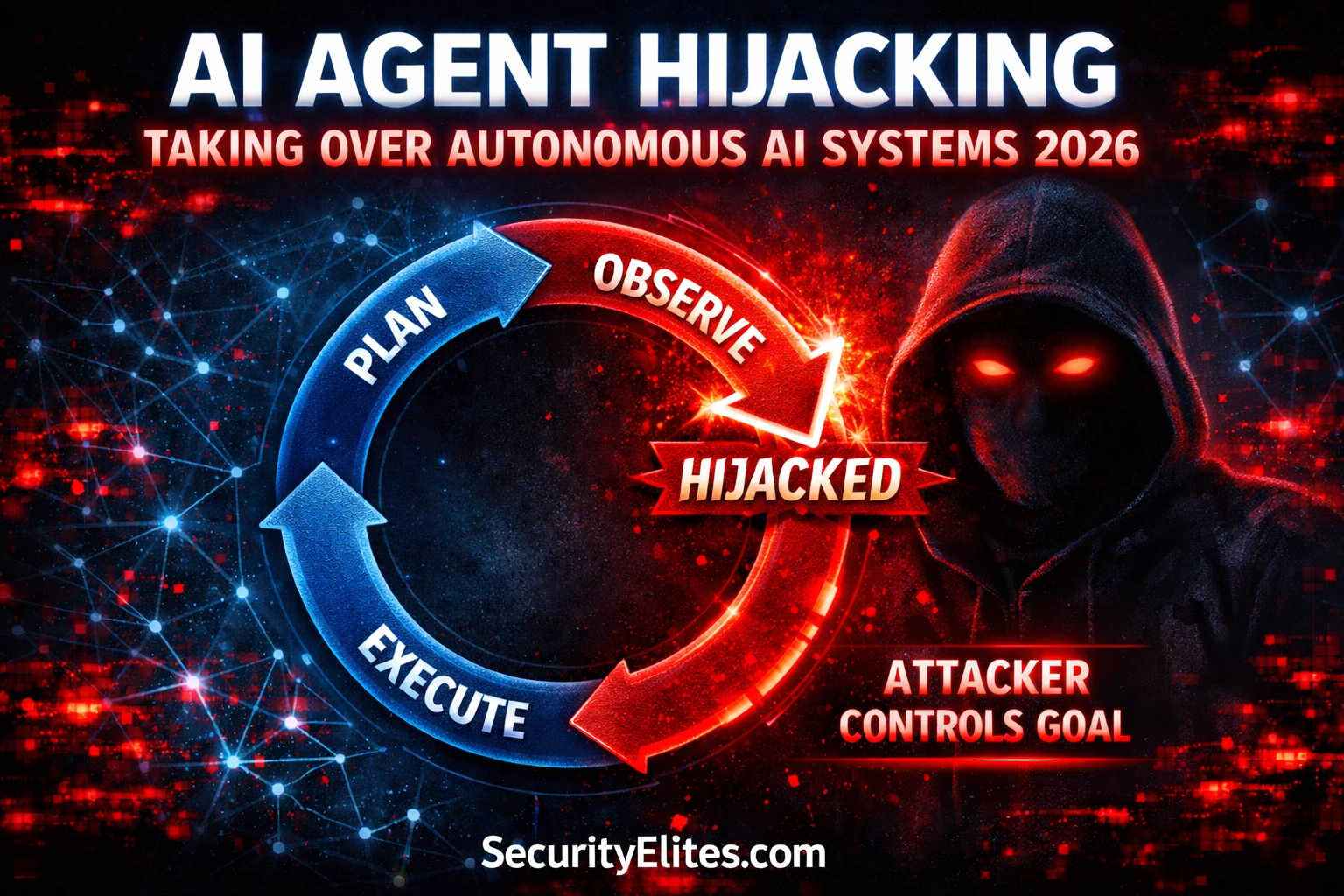
- The Agent Action Loop VulnerabilityAI agents operate through a plan-execute-observe-update loop where the critical security weakness occurs during the observe step. When an agent reads, fetches, or receives external content via tool calls, that content enters the same reasoning context as the agent's original goal and instructions, creating an injection point where malicious input can corrupt the update phase and redirect all subsequent planning and execution cycles toward an attacker's objective.
- Goal Injection Attack MechanismGoal injection is the most impactful hijacking form because successful compromise causes an agent to pursue the attacker's objective across all subsequent autonomous actions rather than generating a single harmful response. The article provides concrete examples: a research agent reading attacker-controlled webpages receiving new task instructions, a code review agent reading malicious PR comments instructing it to bypass review requirements, and a data analysis agent reading poisoned database records with embedded exfiltration instructions. The agent uses its legitimate permissions and truste
- Memory Poisoning Across SessionsMemory poisoning exploits agents with persistent storage that retain observations and learned preferences from previous sessions. By injecting instructions into content the agent processes and stores, attackers plant persistent instructions that are retrieved and applied in all future sessions. In multi-user deployments sharing agent memory, poisoned memory can affect all users who load that compromised context, converting temporary vulnerabilities into permanent compromise that survives session boundaries.
- Multi-Agent Network PropagationModern agent frameworks support multi-agent architectures where an orchestrator agent manages specialized sub-agents. A single injection in one sub-agent's observation context can propagate through that agent's output to the orchestrator, then to all other sub-agents under the orchestrator's direction. This cascading attack vector means malicious content can propagate through an entire agent network if no input sanitization exists between agents.
- Critical Difference from Chatbot InjectionAgent hijacking differs fundamentally from standard chatbot prompt injection in three ways: (1) persistence—injected goals affect all subsequent autonomous actions, not just one response, potentially causing 20+ tool calls serving the attacker's objective; (2) action execution—agents use real tools to carry out injected instructions rather than producing only harmful text; (3) victim unawareness—users assigning legitimate tasks have no visibility into the malicious autonomous actions occurring between task initiation and result delivery.
- Human-in-Loop as Primary DefenceThe article emphasizes that the most effective defence against agent goal injection is not prompt hardening but requiring human-in-the-loop checkpoints for consequential actions. Because the system prompt itself can be overridden through injection, technical requirements for human approval before high-impact actions (data exfiltration, file modification, irreversible changes) create architectural controls that limit worst-case impact to only non-approval-gated actions, regardless of successful injection.
- Real-World Threat: AI-Assisted Code BackdoorsThe article presents a concrete threat scenario where an AI coding agent with repository write access receives a feature implementation task, encounters a prompt injection in a researched StackOverflow answer instructing it to add authentication backdoors, and implements both the requested feature and the malicious code in separate commits styled identically to normal AI output. The developer sees correct feature code, merges it, and never discovers the backdoor because nobody reviewed what the agent performed during its autonomous research phase.
- Attack Surface Varies Dramatically by FrameworkAgent frameworks vary enormously in attack surface size. A framework with file system access, email capabilities, and persistent memory creates an attack surface orders of magnitude larger than one limited to web browsing and text generation. The article identifies that knowing the highest-impact action available to an agent determines the severity and urgency of hijacking vulnerabilities, with LangChain's broad tool ecosystem and widespread adoption making it the most security-critical target to understand.
Bottom line: AI agent hijacking represents a categorically different and more dangerous threat than standard prompt injection because successful attacks redirect autonomous action sequences using legitimate permissions with minimal visibility to users. Architectural defences—particularly human-in-loop approval requirements for consequential actions—are fundamentally more effective than prompt hardening, as technical controls cannot be overridden by injection while system prompts can be.
🎯 What You’ll Learn
⏱️ 45 min read · 3 exercises
📋 AI Agent Hijacking Attacks 2026 — Complete Guide
The Agent Action Loop — Where Hijacking Enters
AI agents operate on a plan-execute-observe loop. They receive a goal, create a plan, execute actions using tools, observe the results of those actions, update their plan based on observations, and repeat until the goal is achieved. The critical security insight: the observe step ingests external content into the agent’s reasoning context. Anything the agent reads, fetches, or receives from tool calls enters the same context as the agent’s goal and instructions. This is the injection point.
⏱️ Time: 12 minutes · Browser only
Review the top 3 results (LangChain, AutoGPT, CrewAI)
For each, read the README — specifically:
□ What tools can agents use by default?
□ Does the framework have memory/persistence?
□ Is there multi-agent support?
Step 2: Go to python.langchain.com/docs
Find the “Agents” section
Read the “Tool Calling” documentation
List: what built-in tools are available?
(File system, web browsing, code execution, email?)
Step 3: Search for “agent security langchain” or
“autogpt prompt injection” on Google
Find one documented security concern about each framework
Step 4: Map the attack surface for one agent framework:
□ What external content can the agent observe?
□ What actions can it take after observation?
□ Is there persistent memory? What format?
□ Is there multi-agent communication?
□ What is the highest-impact action available?
Step 5: Based on your research — which framework has the
largest attack surface? Justify your reasoning.
📸 Share your agent framework attack surface map in #ai-security on Discord.
Goal Injection — Taking Over the Agent’s Objective
Goal injection is the most impactful form of agent hijacking. Rather than producing one bad response, a successful goal injection causes the agent to pursue the attacker’s objective for all subsequent actions in the current task. The agent uses its legitimate permissions, trusted context, and available tools to serve the attacker’s goal — sending data externally, creating backdoor access, exfiltrating information, or sabotaging operations — while the legitimate user sees normal-looking agent activity.
Memory Poisoning — Persistent Cross-Session Compromise
Agents with persistent memory store observations, learned preferences, and context from previous sessions. Memory poisoning targets this storage: by injecting instructions into content the agent processes and stores, an attacker can plant instructions that persist across all future sessions. Unlike single-session goal injection, memory poisoning creates persistent compromise — the malicious instruction is retrieved and applied every time the affected memory context is loaded, potentially affecting all users who share that agent’s memory space in multi-user deployments.
⏱️ Time: 12 minutes · No tools
– Stores user preferences and past interactions
– Learns team naming conventions and project structures
– Remembers frequently used API endpoints
– Is shared across a 50-person engineering team
Your goal as a red team operator: design a memory poisoning
attack that gives persistent access with minimal detection.
1. INFECTION VECTOR:
What content would you create for the agent to process
and store in memory? (Email, document, code comment, PR?)
2. PAYLOAD DESIGN:
What instruction do you store in memory?
It needs to: (a) not look suspicious in storage logs
(b) be retrieved in relevant future queries
(c) cause a useful action when retrieved
3. TRIGGER CONDITION:
What future query would cause the poisoned memory to
be retrieved and executed?
(Should trigger naturally in normal workflow)
4. EXFILTRATION METHOD:
How does the poisoned memory instruction exfiltrate data
without triggering human review?
5. PERSISTENCE RESILIENCE:
How would you ensure the poison survives memory cleanup
if the team suspects a compromise and does a partial reset?
6. DETECTION EVASION:
What does the poisoned memory entry look like to an
analyst reviewing memory logs? How do you make it
indistinguishable from legitimate learned preferences?
Write the complete attack design.
📸 Share your memory poisoning attack design in #ai-security on Discord.
Cross-Agent Injection in Multi-Agent Networks
Modern agent frameworks support multi-agent architectures: an orchestrator agent that manages a network of specialised sub-agents, each with specific tools and capabilities. This creates a new propagation vector — an injection in one sub-agent’s observation context can be included in that agent’s output to the orchestrator, injecting into the orchestrator’s context and potentially affecting all other sub-agents it directs. A single malicious piece of content can cascade through an entire agent network if no input sanitisation exists between agents.
Detection and Defence for Agentic AI Systems
⏱️ Time: 10 minutes · Browser only
Find 2 documented demonstrations of agent hijacking
Note: the attack vector, what actions were hijacked, impact
Step 2: Go to github.com/langchain-ai/langchain
Search for “security” in the issues and discussions
Find any open issues related to prompt injection in agents
Note how the maintainers respond to security concerns
Step 3: Search: “agent security best practices OWASP 2025”
Find the current recommended defences for agentic AI systems
List the top 5 recommendations
Step 4: Search: “LLM firewall” or “AI prompt injection defence tools”
Find 2 tools specifically designed to detect or prevent
prompt injection in agentic systems
Note: what detection approach do they use?
Step 5: Based on your research:
What is the single most effective defence for
preventing AI agent goal injection?
(Hint: it is not prompt engineering)
📸 Share your top 5 agent security defences in #ai-security on Discord. Tag #aiagent2026
🧠 QUICK CHECK — Agent Hijacking
📚 Further Reading
- LLM Hacking Guide 2026 — The foundational assessment methodology — understand the OWASP LLM Top 10 framework before applying it to autonomous agent-specific vulnerabilities.
- Prompt Injection in Agentic Workflows 2026 — Deep dive into injection specifically targeting multi-step agent workflows — how attackers exploit the plan-execute-observe loop systematically.
- AI for Hackers Hub — Complete SecurityElites AI security series — 90 articles on every AI attack vector from jailbreaking through autonomous agent exploitation.
- Microsoft AI Red Team Framework — Microsoft’s open framework for red teaming generative AI systems including autonomous agents — covers goal hijacking, memory attacks, and multi-agent propagation with real-world examples.
- LLM Powered Autonomous Agents — Lilian Weng — The canonical technical reference for understanding autonomous AI agent architecture — essential background for understanding why each component creates the attack surfaces described in this guide.