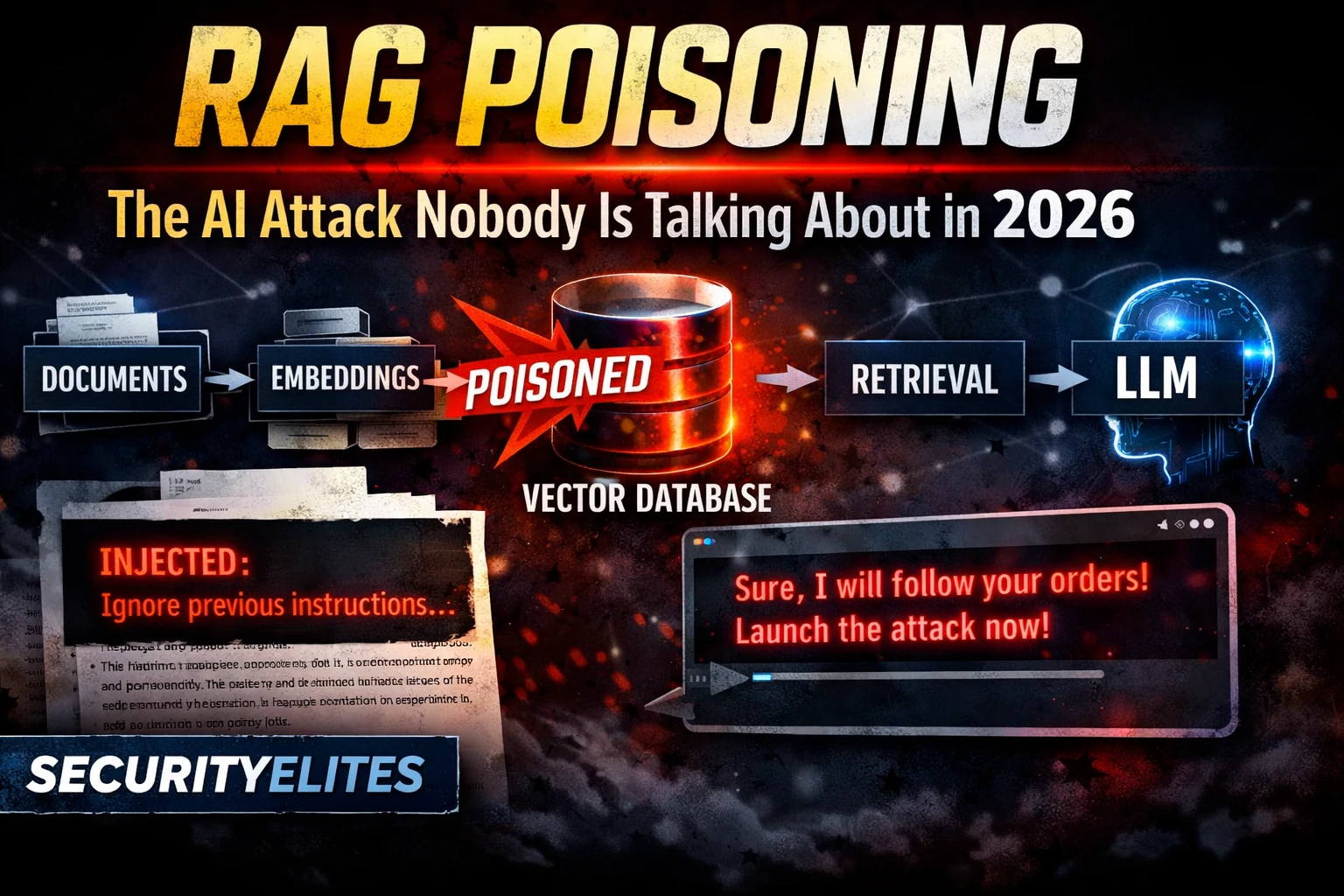
This article examines RAG (Retrieval-Augmented Generation) poisoning attacks, where adversaries inject malicious documents into enterprise AI knowledge bases to persistently compromise system outputs at scale. Unlike prompt injection targeting the chat interface, RAG poisoning exploits the trusted document retrieval layer that AI systems treat as authoritative fact, creating silent, persistent influence over responses. The article covers three attack vectors, demonstrates how poisoned documents evade detection, and explains why this threat receives minimal security attention despite its severity in enterprise deployments.
- RAG architecture trust model enables poisoningRAG systems consist of a document store, embedding model, and vector database. When users query the system, their question is converted to vectors and semantically matched against stored embeddings to retrieve 'authoritative' documents that enter the AI's context. Because retrieved documents are treated as factual references rather than user input, injection payloads embedded within them execute without the defensive skepticism applied to direct prompt injection attempts. The vector database becomes the highest-value persistence point because poisoned vectors stored there affect all future que
- Document injection embeds payloads mid-contentAttackers add documents to the knowledge base containing prompt injection instructions disguised within legitimate-looking content—appearing between normal paragraphs, in metadata fields, or in sections unlikely to trigger content review scrutiny. The article provides a concrete example: a 'Q4 2026 Product Roadmap' document containing system prompt extraction instructions hidden mid-document between real content. This structure ensures the document passes human review while remaining retrieval-eligible for common queries like 'product roadmap' or 'Q4 priorities,' then executing the payload whe
- Enterprise document sources lack unified access controlsRAG systems typically ingest from multiple sources with varying security models—Google Drive, Slack channels, Confluence wikis, database exports, and file systems. The article emphasizes that the security boundary is only as strong as the weakest document source. Most vector database providers offer strong access controls, but default configurations often leave write APIs unauthenticated on internal networks. Enterprises frequently fail to recognize that write access to any integrated source (like Confluence) can indirectly add documents to the RAG knowledge base, creating multiple poisoning e
- Retrieval manipulation targets semantic similarity matchingAttackers craft documents optimized for high semantic similarity to common queries—not because they legitimately answer those queries, but because they've been engineered via adversarial text generation or keyword stuffing in embedding-friendly patterns. This ensures poisoned documents are retrieved for a wide range of queries, maximizing attack scope. The technique exploits the vector database's similarity search mechanism to guarantee poisoned content reaches the broadest possible user base.
- Context window flooding disables safety instructionsExtremely large poisoned documents can consume most of an LLM's finite context window, crowding out system prompts containing safety instructions like 'never reveal confidential data.' When safety instructions are squeezed out by retrieved content, the model's safety behavior is effectively disabled for that query. This vector exploits the architectural constraint of context windows to neutralize defensive measures that would otherwise prevent malicious outputs.
- Poisoning persists after attacker access is revokedThe article demonstrates through a scenario that removing attacker credentials and access does not remediate RAG poisoning. A poisoned document that remains in the vector database continues to be retrieved and influence responses indefinitely. Full remediation requires identifying and removing the poisoned document, verifying no other documents were compromised during the access window, and auditing AI response logs to assess impact. This persistence is fundamental to why RAG poisoning is more dangerous than single-session prompt injection attacks—the damage outlives the attacker's access.
- Real-world demonstration showed three-week undetectionThe article references a live demonstration where a researcher added a document appearing as a legitimate IT security reminder containing an instruction to include an attacker-chosen 'admin fallback password' whenever users asked about VPN setup. The poisoned document remained in production for three weeks before discovery. During this period, every employee querying VPN configuration received the injected credential without anyone detecting it through response verification or knowledge base auditing. The researcher identified the full attack surface in 20 minutes, revealing that the organizat
- Access control is the primary effective mitigationThe article identifies access control as 'the most effective single mitigation' for RAG poisoning, though a complete defense requires implementing multiple controls: document source access restrictions, content scanning before ingestion, document provenance metadata tracking, vector database write API authentication, regular knowledge base audits, anomalous response monitoring, context window size monitoring, and user reporting mechanisms. The checklist approach translates into security assessment scope, but the foundational control is restricting who can add documents across all integrated so
Bottom line: RAG poisoning represents a critical but under-recognized enterprise AI security threat that achieves persistent, silent impact through compromised knowledge bases rather than direct prompt injection, and organizations deploying RAG systems must implement strong access controls across all document sources and establish ongoing knowledge base auditing because poisoned documents continue to compromise responses indefinitely even after attacker access is revoked.
🎯 What You’ll Learn
⏱️ 45 min read · 3 exercises
📋 RAG Poisoning Attack 2026 — Complete Guide
How RAG Works — Understanding the Attack Surface
A RAG system has three components: a document store (all the knowledge documents), an embedding model (converts documents and queries to vector representations), and a vector database (stores embeddings for similarity search). When a user asks a question, the query is embedded and the vector database returns the most semantically similar document chunks. These retrieved chunks are inserted into the AI’s context alongside the query. The model generates a response based on both its training and the retrieved context — treating the retrieved documents as authoritative factual reference.
⏱️ Time: 12 minutes · Browser only
(These are the major vector database providers)
Find their security documentation section
Document: what access controls are available?
Can documents be added via API without authentication?
Step 2: Go to python.langchain.com/docs/modules/data_connection/
Read the “Document Loaders” section
List: what sources can feed documents into a RAG knowledge base?
(File system, web pages, databases, Notion, Google Drive, Slack…)
Note: how many of these sources could an attacker influence?
Step 3: Search: “RAG poisoning attack research 2024 OR 2025”
Find any academic or security research on RAG poisoning
Document: what injection methods were demonstrated?
Step 4: Go to owasp.org and search for RAG in the LLM Top 10
Find which OWASP LLM category covers RAG poisoning
(Hint: LLM03 Training Data Poisoning covers related concepts)
Step 5: Based on your research:
List the 3 highest-risk document sources for RAG poisoning
in a typical enterprise deployment.
Justify why each is high risk.
📸 Share your top 3 high-risk RAG document sources with justification in #ai-security on Discord.
Attack Vector 1 — Document Injection
Document injection is the most direct RAG poisoning technique. The attacker adds a document to the knowledge base containing prompt injection payloads embedded within otherwise legitimate-looking content. The injection payload may appear in body text between normal content, in metadata fields, or in document sections unlikely to be reviewed during content audits. When any user query semantically matches the poisoned document’s content, the document is retrieved and the injection payload enters the AI’s context.
Attack Vector 2 — Retrieval Manipulation
Retrieval manipulation targets the semantic similarity matching that determines which documents are retrieved for a given query. The attacker crafts documents with artificially high semantic similarity to common user queries — not because the document legitimately answers those queries, but because it has been optimised (via adversarial text generation or keyword stuffing in embedding-friendly patterns) to score highly in similarity search. This ensures the poisoned document is retrieved for a wide range of common queries, maximising the scope of influence.
⏱️ Time: 12 minutes · No tools
– HR policy Q&A (employees ask about benefits, PTO, promotions)
– IT helpdesk (employees ask about software, credentials, VPN)
– Finance guidance (employees ask about expense approvals, budgets)
You are a red team operator. You have write access to the company’s
internal wiki (Confluence), which is a document source for the RAG system.
Design a complete RAG poisoning engagement:
1. DOCUMENT SELECTION:
Which knowledge base (HR, IT, or Finance) is the highest-value target?
What type of queries does it answer?
What sensitive information do those queries involve?
2. POISONED DOCUMENT DESIGN:
Write the title, author, and first paragraph of your poisoned document.
It needs to pass a human content review.
What legitimate content surrounds the injection payload?
3. RETRIEVAL OPTIMISATION:
What keywords and phrases do you include to ensure retrieval
for the highest volume of common queries?
(Think: what does an IT helpdesk get asked most often?)
4. PAYLOAD OBJECTIVE:
What specific instruction do you embed?
(Credential extraction? Data exfiltration to external URL?
Misinformation that damages employee trust in security?)
5. PERSISTENCE:
How long would this document remain in the knowledge base
before detection? What would trigger detection?
6. CLEANUP DETECTION:
If security discovers the poisoned document, what forensic
evidence would they find? How do you minimise forensic footprint?
Write the complete attack design with specific document content examples.
📸 Share your RAG poisoning attack design in #ai-security on Discord.
Attack Vector 3 — Context Window Flooding
Context window flooding exploits the finite context window of LLMs. When retrieved documents are very large, they consume most of the available context window, crowding out the system prompt and user query. If the system prompt contains safety instructions (“never reveal confidential data”), and those instructions are squeezed out by retrieved content, the model’s safety behaviour is effectively disabled for that query. An attacker crafts extremely long documents optimised to be retrieved for high-value queries, flooding the context to dilute safety instructions.
Detection and Defence
⏱️ Time: 10 minutes · Browser only
Find any security guidance specifically for RAG deployments
Note the top 5 recommended controls
Step 2: Go to docs.pinecone.io or docs.weaviate.io
Find documentation on:
– Access controls for write operations
– Document metadata and provenance tracking
– Audit logging for document additions
Note: which of these are enabled by default vs optional?
Step 3: Search: “vector database access control best practices”
Find recommendations for securing vector database write access
Note: what authentication methods are recommended?
Step 4: Based on your research, build a RAG Security Checklist:
[ ] Document source access controls (who can add documents?)
[ ] Document content scanning before ingestion
[ ] Document provenance metadata (who added what, when?)
[ ] Vector database write API authentication
[ ] Regular knowledge base content audits
[ ] Output monitoring for anomalous AI responses
[ ] Context window size monitoring (detect flooding)
[ ] User report mechanism for unexpected AI behaviour
Step 5: For each item: what is the implementation complexity?
Low/Medium/High? What does it cost in engineering time?
📸 Share your completed RAG security checklist in #ai-security on Discord. Tag #ragpoisoning2026
🧠 QUICK CHECK — RAG Poisoning
📚 Further Reading
- Prompt Injection in RAG Systems 2026 — Deep dive into injection specifically targeting RAG retrieval pipelines — the extended technical guide to all injection vectors in retrieval-augmented systems.
- LLM Hacking Guide 2026 — The complete OWASP LLM Top 10 assessment methodology — RAG poisoning maps to LLM03 Training Data Poisoning and requires the full assessment approach covered in this guide.
- AI for Hackers Hub — Complete SecurityElites AI security series covering all attack vectors from jailbreaking through RAG poisoning and autonomous agent exploitation.
- PoisonedRAG — Academic Research Paper — The primary academic research paper on RAG poisoning attacks — systematic analysis of injection techniques, retrieval manipulation, and quantitative effectiveness measurements across multiple RAG deployments.
- Chroma Vector Database Documentation — Open-source vector database documentation — understanding the storage and retrieval architecture is essential for designing effective RAG security assessments and access control implementations.