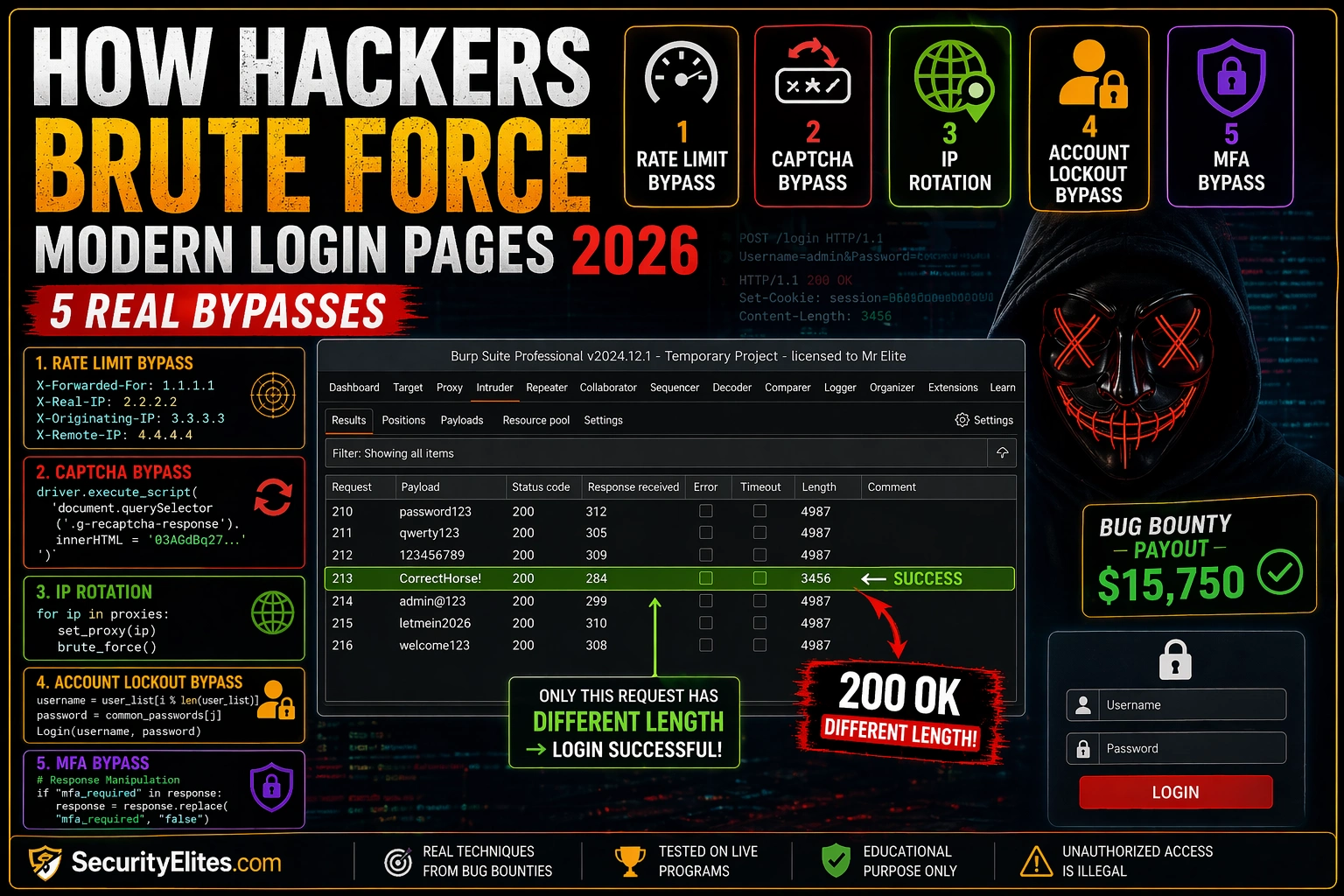
This article systematically demonstrates five real authentication bypass techniques that security researchers consistently find on production login pages. Rather than attempting traditional brute force attacks against modern protections, the article shows how authentication controls fail due to implementation flaws—when developers secure one layer but leave another vulnerable, or trust headers they shouldn't. Understanding these specific bypasses and how to test for them methodically increases bug bounty payout success, particularly when findings are chained together to demonstrate complete account takeover.
- Rate limiting bypass via IP header injectionModern applications often implement rate limiting by tracking failed attempts per source IP rather than per account. If the application trusts proxy headers like X-Forwarded-For, X-Real-IP, or True-Client-IP, an attacker can rotate these header values with each request to reset the attempt counter. The test is trivial: send a failed login with X-Forwarded-For: 10.0.0.1, then resend with X-Forwarded-For: 10.0.0.2—if the counter resets, unlimited password attempts become possible. This can be automated in Burp Intruder using Pitchfork mode with sequential IPs as one payload set and passwords as
- CAPTCHA token reuse vulnerabilityMany implementations accept CAPTCHA response tokens without enforcing single-use restrictions. After solving a CAPTCHA manually and capturing the g-recaptcha-response parameter, an attacker can replay the identical token value across unlimited subsequent login attempts. The application never re-prompts for CAPTCHA, allowing one manual solve to protect an entire automated credential-stuffing attack. Testing requires only solving the CAPTCHA once in a browser, capturing the token in Burp, and replaying the same token value across multiple requests with different passwords—any request beyond the
- Username enumeration through response timingEven when applications normalize error messages to prevent enumeration, timing analysis reliably identifies valid usernames. Valid username submissions trigger database lookups and intentionally-slow password checks (like bcrypt), producing response times 50-200ms longer than invalid usernames which return immediately. Running Burp Intruder in Sniper mode with a username wordlist and constant wrong password, then sorting results by response time, visibly clusters valid usernames at one timing band and invalid usernames at another. The article demonstrates a real example where valid usernames s
- Account lockout logic implementation flawsLockout mechanisms frequently contain exploitable logic errors beyond per-IP tracking. The article identifies a secondary common flaw: lockout counters that don't properly reset on successful authentication attempts, creating a bypass through alternating correct and incorrect passwords—the counter never reaches the threshold. Additionally, password spraying (one password tested against many usernames) exploits per-account lockout policies: testing one password like 'Summer2026!' across 500 company accounts means each account receives only one failed attempt, never triggering the N-attempt lock
- MFA OTP brute force from missing rate limitingThe most consistent MFA implementation flaw is rate limiting presence on the username/password form but complete absence on the OTP entry form. A 6-digit TOTP has only 1,000,000 possible values; without rate limiting on OTP submission, automated testing can exhaust all possibilities in under two minutes. The test requires using valid credentials to reach the OTP entry form (using your own test account), then sending OTP form submissions to Burp Intruder with a 6-digit number sequence payload and monitoring response length variations—responses differing from the 'wrong OTP' baseline indicate va
- Chaining bypasses into critical-severity findingsIndividual authentication bypasses typically rate as Medium severity, but the article demonstrates how systematic chaining produces Critical ratings. One documented real engagement combined: timing enumeration identifying 340 valid usernames, X-Forwarded-For rotation bypassing rate limiting, CAPTCHA token reuse removing CAPTCHA protection, credential stuffing from breach databases against the enumerated usernames, and discovering 11 working accounts (six without MFA due to incomplete rollout). The article emphasizes reporting the complete attack chain with a numbered table showing exactly whic
- Testing methodology and scope constraintsThe article emphasizes that all authentication testing must use dedicated test accounts the researcher controls, never affecting production user accounts or other users. This ethical constraint is fundamental to legitimate bug bounty work—authentication testing on other users' accounts 'crosses an ethical and legal line.' The article recommends registering proper test accounts through each programme's process, reviewing programme policies to confirm authentication testing is explicitly in scope, and checking disclosed reports before testing to avoid duplicates. Many programmes require notifica
- Implementation flaws replicate across organizationsThe article argues these aren't exotic attacks but systematic implementation failures appearing repeatedly because developers face identical time pressure and lack authentication testing in standard QA processes. The same five bypass techniques appear consistently across different companies and years on bug bounty platforms like HackerOne—the article recommends studying disclosed reports to understand patterns. Response indicates the 'gap' in what's already been tested on a specific programme is where new findings live, suggesting researchers should check historical reports before testing a ta
Bottom line: Modern login pages fail not because security controls don't exist, but because individual layers contain implementation flaws that remain undetected—attackers and security researchers systematically test each protection independently (rate limiting, CAPTCHA, account lockout, MFA) for specific weaknesses like header injection or token reuse, then chain these bypasses together to demonstrate complete account takeover. Mastering these five testable-in-minutes bypass techniques and documenting them
That’s because modern login pages don’t have one protection — they have layers. Rate limiting. Account lockout. CAPTCHA. MFA. IP reputation checks. The hunters consistently finding authentication bypass findings on major bug bounty programmes aren’t brute-forcing in the traditional sense. They’re testing whether each protection layer actually works, and finding the specific implementation flaws where one layer fails without breaking the others.
I’ve found rate limiting bypasses on FTSE 100 company login pages by adding a single header. I’ve found CAPTCHA token reuse on a financial services platform that meant the CAPTCHA provided exactly zero protection. I’ve found MFA OTP brute force on a healthcare portal with no rate limiting on the OTP entry form. These aren’t exotic attacks — they’re systematic testing of controls that developers implemented incorrectly. Here are the five that pay most consistently.
🎯 What You’ll Know After This
⏱️ 25 min read · applicable to your next bug bounty session
📋 How Hackers Brute Force Modern Login Pages – Contents
Bypass 1 — Rate Limit via IP Header Injection
Rate limiting should track failed attempts by account, not by IP. But a lot of implementations track by source IP — because it’s simpler to implement. That implementation choice creates the bypass: if the application respects the X-Forwarded-For header as the source IP, rotating that header value resets your attempt counter.
The test takes two minutes. Add an X-Forwarded-For header with a fake IP to your login request. Confirm the application accepts it (no error). Then change the IP value and retry a failed attempt — does the failed attempt counter reset? If yes, the rate limiting is bypassable by anyone who can send custom headers. In Burp Intruder, use a Pitchfork attack type with one payload on the password field and one on the X-Forwarded-For value.
Bypass 2 — CAPTCHA Token Reuse
Most developers implement CAPTCHA by integrating Google reCAPTCHA or hCaptcha and checking that the response token is valid. What many don’t implement: checking that the token hasn’t been used before. A valid solved token should be single-use. If the server accepts the same token on multiple requests, CAPTCHA provides no protection against automated testing — you solve it once manually and replay that token indefinitely.
The test is trivial. Solve the CAPTCHA once normally, capture the g-recaptcha-response parameter in Burp, and replay the login request with that same value multiple times. If subsequent requests succeed despite the token being “used,” token reuse is confirmed.
Bypass 3 — Username Enumeration via Timing
Before brute-forcing anything, you want to know which usernames exist. The most reliable enumeration technique that survives normalised error messages is timing analysis. When you submit a valid username with a wrong password, the application does a database lookup, finds the account, then checks the password — that takes measurable time. When you submit an invalid username, the application either skips the password check or returns immediately — slightly faster.
The timing difference is often only 50-200ms, but it’s consistent. Run Burp Intruder with a username wordlist, constant wrong password, and sort results by response time. Valid usernames cluster at one timing band, invalid ones at another. On large user populations this gives you a confirmed valid username list before you attempt a single password.
Bypass 4 — Account Lockout Logic Flaws
Account lockout is often implemented with subtle logic errors. The most common: lockout per IP, not per account — already covered in Bypass 1. The second most common: the lockout counter doesn’t reset correctly. Test whether a correct password attempt resets the lockout counter, or whether it persists regardless of correct attempts in between. A counter that resets on any successful interaction (not just the same account) creates a bypass: alternate between correct and wrong passwords with the counter never reaching the threshold.
The most complete chain I’ve documented on a real engagement: timing analysis confirmed 340 valid usernames from a company’s login page. X-Forwarded-For rotation bypassed the 10-attempt rate limit. CAPTCHA token reuse eliminated the CAPTCHA layer entirely. Credential stuffing from a 2022 breach database against the valid username list returned 11 working account credentials. Six of those accounts had no MFA because they were contractor accounts the IT team had deprioritised in the MFA rollout. That’s a complete path from zero knowledge to eleven authenticated sessions — every step enabled by a different bypass finding, each one Medium-rated individually, collectively Critical. The report structure that got it triaged as Critical immediately: a numbered attack chain table showing exactly which bypass enabled which step, with the full impact at the bottom. Individual findings submitted separately would have been five Medium payouts. Submitted as a chain with documented impact: one Critical.
Password spraying is the anti-lockout technique. One password per account. Lockout triggers after N failed attempts per account. With one attempt per account, no individual account ever reaches N. Against an organisation with 500 employees, testing password “Summer2026!” against all 500 accounts triggers zero lockouts while finding anyone using that exact password.
Bypass 5 — MFA OTP Rate Limiting Absence
Here’s the MFA implementation flaw I find most consistently: rate limiting exists on the username/password form, but not on the OTP entry form. The developer secured the first step thoroughly and forgot the second step is also a brute-force surface. A 6-digit TOTP has 1,000,000 possible values. With no rate limiting on OTP entry, you can brute force it in under two minutes with automated requests.
The test: get past the first authentication step with valid credentials (your own test account), arrive at the OTP entry form, and send that form submission to Burp Intruder. Load a 6-digit number sequence as the payload. Start the attack and watch the response lengths. Any response with a different length from the “wrong OTP” baseline indicates a valid OTP or a different error — investigate it.
⏱️ 15 minutes · Browser only
The best way to understand what’s actually finding real payouts is reading the reports. Real bug bounty reports show exactly what the researcher tested, what they found, and what the impact was rated. Start here before testing anything yourself.
Go to: hackerone.com/hacktivity
Filter: Vulnerability type = “Improper Authentication”
Read 3 disclosed reports involving rate limiting or account lockout
Step 2: Search for CAPTCHA bypass reports
hackerone.com/hacktivity → search “CAPTCHA bypass”
What bypass technique was used in each report?
What was the CVSS score assigned?
Step 3: Search for MFA bypass reports
hackerone.com/hacktivity → search “MFA bypass” or “OTP bypass”
How many involve rate limiting on the OTP form specifically?
What’s the most common impact description?
Step 4: Find a credential stuffing or password spraying report
Search: “password spraying” OR “credential stuffing” site:hackerone.com
What organisational conditions made the attack successful?
Was account lockout present? If so, how was it bypassed?
Step 5: Calculate average payout
From your 5 reports: what was the median bounty amount?
What was the severity distribution (Low/Med/High/Critical)?
Which bypass type paid most consistently?
📸 Screenshot a disclosed rate limiting bypass report from HackerOne. Share in #bug-bounty
| # | Password | X-Forwarded-For | Status | Length |
| 1 | password123 | 10.0.0.1 | 200 | 842 |
| 2 | Summer2026! | 10.0.0.2 | 200 | 842 |
| 3 | Welcome@1 | 10.0.0.3 | 200 | 3847 |
| 4 | qwerty123 | 10.0.0.4 | 200 | 842 |
⏱️ 15 minutes · No tools needed
Before you run any of these tests on a real target, you need a systematic checklist that covers every protection layer without missing anything. Build it here, from scratch, using what you’ve just learned.
with exactly 10 items covering all 5 bypass types.
For each item, specify:
– What you’re testing (1 sentence)
– How you test it (specific technique or Burp tool)
– What outcome confirms vulnerability
Start with these categories and add 2 items per category:
1. Rate Limiting (2 tests)
2. CAPTCHA (2 tests)
3. Username Enumeration (2 tests)
4. Account Lockout (2 tests)
5. MFA (2 tests)
BONUS: For each vulnerability type, identify:
– Minimum Burp Suite tool needed to test it
– Approximate time to test (in minutes)
– Realistic CVSS range for a confirmed finding
CONSTRAINT: None of your tests should affect other users
in a production system. All tests use your own test accounts.
How does this constraint change any of your 10 test designs?
📸 Post your 10-item checklist in #bug-bounty. Get feedback on anything you missed.
Chaining: Enumeration + Bypass = Account Takeover
Individual authentication bypass findings rate Medium in most programmes. Chain them together and you’re at Critical. Here’s the chain I’ve demonstrated on real engagements: timing enumeration gives you a list of valid usernames → rate limit bypass via X-Forwarded-For gives you unlimited attempts → credential stuffing with breach data against those valid usernames → account takeover.
None of those individual findings is Critical in isolation. Together, the attack path goes from “I know nothing about the application” to “I have account access” without triggering a single protection. That’s the bug bounty report structure that generates Critical payouts: not one finding, but a documented chain with each step and the cumulative impact.
| Username | Status | Response Time | Length | Valid? |
| notauser | 200 | 48ms | 842 | No |
| alice | 200 | 312ms | 842 | Yes ← |
| fakeuser | 200 | 51ms | 842 | No |
| bob.smith | 200 | 298ms | 842 | Yes ← |
⏱️ 15 minutes · HackerOne or Bugcrowd account
Your next step after reading this article is finding a real target where authentication bypass testing is explicitly in scope. Here’s how to find the right programme.
hackerone.com/programs → filter by “authentication” in scope
Or search: programme policies mentioning “rate limiting”, “brute force”
Step 2: Read the programme policy carefully
Is brute force testing explicitly allowed or excluded?
What test account process does the programme require?
Is there a staging environment for testing?
Step 3: Find 3 programmes that explicitly allow authentication testing
Document: programme name, scope, test account method, bounty range
Step 4: For each programme, check disclosed reports
Has anyone already reported rate limiting bypass on this programme?
What was the outcome? Was it accepted or marked as informational?
Step 5: Choose one programme and complete the test account setup
Register a legitimate test account following the programme’s process
Note: some programmes require notifying them before authentication testing
Confirm the test account email is yours and the account is yours to test with
📸 Screenshot the programme policy section confirming authentication testing is in scope. Share in #bug-bounty
✅ 5 Authentication Bypass Techniques — Ready to Apply
Rate limit via IP header, CAPTCHA token reuse, timing enumeration, lockout logic flaws, MFA OTP rate limiting — five systematic tests, each applicable in under five minutes, each finding payouts consistently on major programmes. The next authentication form you encounter gets all five.
🧠 Quick Check
❓ Brute Force & Auth Bypass FAQ
How do hackers bypass rate limiting on login pages?
What is credential stuffing and how is it different from brute force?
Can CAPTCHAs be bypassed in bug bounty testing?
Is testing login page brute force protections legal for bug bounty?
What is password spraying?
What CVSS score does a rate limiting bypass get?
Gobuster vs ffuf vs Feroxbuster 2026
Social Engineering Scripts Pentesters Use
📚 Further Reading
- Day 22 — GraphQL Bug Bounty — GraphQL APIs frequently have weaker authentication controls than REST endpoints — the same systematic testing approach from this article applies directly to GraphQL login and auth mutations.
- Day 16 — Rate Limiting Bug Bounty — The dedicated rate limiting course module with additional bypass techniques covering non-login endpoints like password reset, OTP generation, and email verification flows.
- How Hackers Bypass 2FA in 2026 — Full coverage of MFA bypass beyond OTP brute force — SIM swapping, SS7 attacks, real-time phishing proxies, and session token theft after MFA completion.
- PortSwigger — Authentication Vulnerabilities Labs — Free lab environment covering every authentication bypass technique covered above with guided exercises and working solutions.
- HackerOne Hacktivity — Disclosed Reports — Search “rate limiting” or “CAPTCHA bypass” to read real disclosed reports — the fastest way to understand what these findings look like in practice and how triagers rate them.