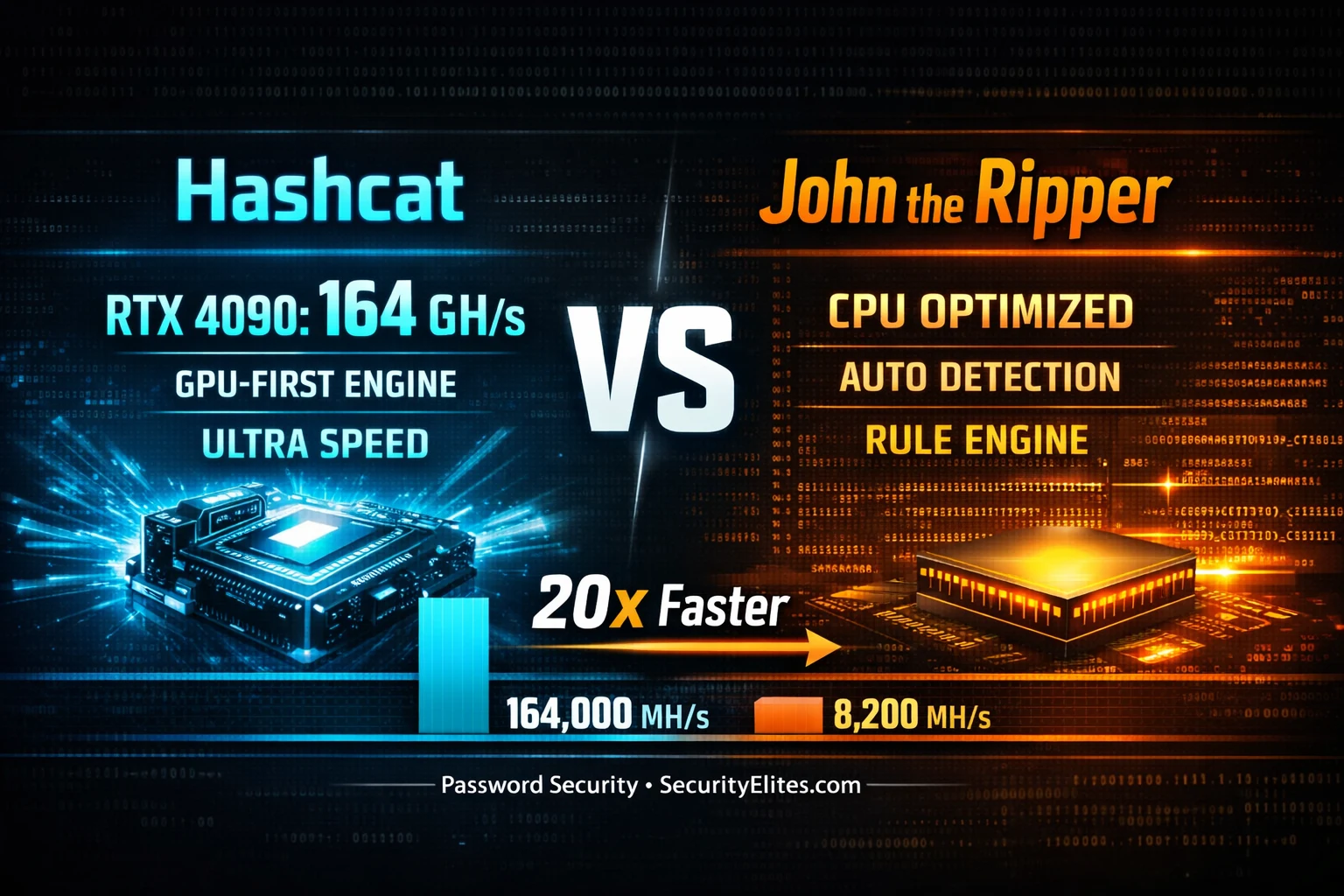
This article provides a technical comparison of Hashcat and John the Ripper for password cracking in 2026, presenting concrete benchmark data showing Hashcat's GPU advantage (15-20x faster for fast hashes) while establishing that John remains viable for CPU-only environments. The article addresses when to use each tool, how to maximize effectiveness through rule-based attacks, and provides practical commands, scenarios, and exercises for penetration testers. Understanding tool selection and attack methodology directly impacts assessment efficiency and crack rates.
- GPU advantage narrows for bcryptThe benchmark table shows Hashcat on RTX 4090 achieves 184,000 H/s for bcrypt cost=5 versus John's 95,000 H/s—only a 2x difference, compared to 15-20x gaps for NTLM and MD5. This occurs because bcrypt's cost factor makes each computation intentionally sequential and memory-intensive, reducing GPU parallelism advantage. Even at modern cost 12, RTX 4090 drops to ~580/s, making only dictionary words practically recoverable.
- Rules engine multiplies wordlist effectivenessHashcat's rules engine transforms single base words into hundreds of candidates through capitalisation, number appends, symbol substitution (a→@, e→3), and suffix addition. The article demonstrates that best64.rule provides a 77x multiplier—rockyou.txt's 14 million words become over 1 billion candidates. OneRuleToRuleThemAll is identified as a quality rule set that cracks most corporate passwords not protected by bcrypt, with the practical example showing rules increased crack rate from 45% to 64% in a real assessment.
- Hardware determines optimal tool selectionThe article establishes that CPU-only environments favour John with targeted wordlists; consumer GPUs make Hashcat viable for NTLM and MD5 but bcrypt remains slow; multiple/high-end GPUs enable Hashcat brute force for shorter passwords; cloud GPU instances (Vast.ai at $0.10-0.50/hour) provide cost-effective temporary access, with an RTX 4090 exhausting rockyou.txt plus best64.rule against NTLM in under a minute for approximately $0.60-1.00.
- John's auto-detection saves preprocessing timeJohn automatically identifies hash formats without requiring mode number specification, particularly useful for /etc/shadow files containing multiple formats or mixed hash files from unknown sources. John natively handles combined username:hash formats and processes shadow file outputs directly with unshadow without pre-processing, whereas Hashcat requires explicit mode numbers (-m flag).
- Hashcat dominates fast hash cracking speedsBenchmark data shows concrete speeds: NTLM 164,000 MH/s (Hashcat RTX 4090) versus 8,200 MH/s (John 16-core CPU); MD5 68,000 versus 4,100; SHA1 23,000 versus 2,800; NetNTLMv2 7,400 versus 420. This GPU parallelism advantage applies to all fast hashes because billions of parallel operations execute simultaneously, making GPU-based cracking orders of magnitude faster for NTLM, MD5, SHA1, and similar algorithms.
- Hash type determines tool and approachThe article provides a reference table mapping attack vectors to specific tools and modes: NTLM uses Hashcat -m 1000 with rules; NetNTLMv2 from Responder uses -m 5600; Linux SHA512crypt uses John with sha512crypt format; bcrypt uses Hashcat -m 3200 despite slower speed; JWT HS256 uses -m 16500; WPA2 uses -m 22000; Kerberoast uses -m 13100. Tool selection varies by hash type's computational properties and available hardware.
- Targeted wordlist supplementation outperforms generic listsThe article's real assessment example demonstrates that adding company-specific words (name, city, product lines) combined with year and symbol rules cracked 400 additional hashes beyond rockyou.txt alone. The author emphasises that penetration testers who crack credentials regularly build company-specific wordlists during OSINT as standard practice, identifying this ten-minute preparation as the highest-return step in Windows assessments.
- bcrypt design specifically defeats GPU advantageThe article explicitly states bcrypt is designed to defeat GPU parallelism advantage through its cost factor, which makes computation intentionally sequential and memory-intensive. This design choice is identified as why bcrypt and Argon2 represent correct password storage practices, while NTLM (still used internally by Windows) remains dangerously exposed to fast cracking when dumped from domain controllers.
Bottom line: For GPU-available penetration testers, Hashcat with rule-based attacks (best64.rule minimum) on rockyou.txt provides the fastest crack rates for common hash types; for CPU-only environments or unknown hash formats, John the Ripper remains competitive due to optimised code paths and auto-detection. In either case, supplementing generic wordlists with company-specific terms during OSINT preparation consistently increases crack rates more effectively than tool selection alone.
🎯 What This Guide Covers
⏱️ 45 min read · 3 exercises
📊 What hardware do you use for password cracking?
📋 Complete Comparison Guide
- The Benchmark Numbers — Real Speed Data for 2026 Hardware
- Hashcat Strengths — GPU, Rules Engine, and Attack Modes
- John the Ripper Strengths — Auto-Detection and CPU Optimisation
- The Attack Workflows That Actually Crack Passwords
- Hash Type Reference — Which Mode, Which Tool, Which Approach
- Cloud GPU Cracking — When Local Hardware Is Not Enough
The Benchmark Numbers — Real Speed Data for 2026 Hardware
The bcrypt row is the most important insight in the table. For fast hashes like NTLM and MD5, a modern GPU has a massive advantage because it can compute billions of parallel hash operations. Bcrypt is specifically designed to defeat this advantage — its cost factor makes each computation intentionally sequential and memory-intensive, reducing GPU throughput to a fraction of what fast hashes achieve. This is why bcrypt and Argon2 are the correct choices for password storage, and why NTLM (which Windows still uses internally) is so dangerous to expose.
Hashcat Strengths — GPU, Rules Engine, and Attack Modes
Hashcat’s primary advantages are its GPU utilisation, its flexible attack modes, and its rules engine. The rules engine is what separates professional crackers from those running plain wordlists — a single rule can generate hundreds of password candidates from one base word by applying transformations: capitalise the first letter, append numbers 0-9, substitute letters for similar symbols (a→@, e→3), add common suffixes (!, 123, 2024). A quality rule set like OneRuleToRuleThemAll combined with rockyou.txt generates over a billion candidates and cracks most corporate passwords that are not bcrypt-protected.
⏱️ Time: 10 minutes · Kali terminal
📸 Screenshot your NTLM and bcrypt benchmarks for both tools and share in #password-cracking on Discord.
John the Ripper Strengths — Auto-Detection and CPU Optimisation
John the Ripper’s main advantage over Hashcat is automatic hash format detection. Point John at a file of hashes and it identifies the format without requiring you to specify a mode number. This is particularly useful when dealing with mixed hash files from /etc/shadow (which contains multiple hash formats) or when you are unsure what algorithm produced a captured hash. John also handles combined username:hash formats natively — shadow file and NTDS extraction outputs work without pre-processing.
The Attack Workflows That Actually Crack Passwords
⏱️ Time: 8 minutes · No tools required
SCENARIO 1:
You extracted 500 NTLM hashes from a Windows domain controller
(secretsdump output). You have an RTX 3080 GPU available.
You have 4 hours before the end of the assessment window.
→ Which tool? Which attack mode? Which wordlist/rules?
→ What percentage do you expect to crack?
SCENARIO 2:
You have a Linux /etc/shadow file with 20 SHA512crypt ($6$) hashes.
You have CPU-only access (no GPU available).
You suspect these are server service account passwords.
→ Which tool? Which wordlist? What additional approach for service accounts?
→ Why is brute force not viable here?
SCENARIO 3:
You captured NetNTLMv2 hashes via Responder on the network.
You have 3 hashes. One belongs to a senior manager.
You have a GPU available but only 1 hour.
→ Tool? Mode? Should you try rules? What targeted wordlist additions?
→ What intelligence about the target would you add to the wordlist?
For each scenario, write: Tool, Mode/Format, Wordlist, Rules Y/N, Expected outcome.
📸 Share your cracking strategy for each scenario in #password-cracking on Discord.
Hash Type Reference — Which Mode, Which Tool, Which Approach
Cloud GPU Cracking — When Local Hardware Is Not Enough
For assessments where local GPU hardware is insufficient, cloud GPU instances provide temporary access to powerful cracking resources at hourly rates. Vast.ai is the most cost-effective option for security research — it offers spot instances with consumer and datacenter GPUs at rates as low as $0.10-0.50/hour. An RTX 4090 on Vast.ai running Hashcat for two hours costs approximately $0.60-1.00 and would exhaust rockyou.txt with the best64 rule set against NTLM hashes in under a minute.
⏱️ Time: 15 minutes · Kali terminal · hashcat + john installed
📸 Screenshot cracked passwords from both tools and share in #password-cracking on Discord. Tag #hashcatvsjohn2026
🧠 QUICK CHECK — Password Cracking
📋 Hashcat vs John — When to Use Which
❓ Frequently Asked Questions
Is Hashcat faster than John the Ripper?
What hash types does Hashcat support?
When should I use John instead of Hashcat?
What is the best wordlist for password cracking in 2026?
Can bcrypt passwords be cracked with Hashcat?
180-Day Kali Linux Mastery Course
Password Cracking Category Hub
📚 Further Reading
- Pass the Hash & Pass the Ticket 2026 — The prerequisite step that produces the NTLM hashes you crack with Hashcat — understanding how hashes are extracted from Windows systems contextualises why cracking them matters.
- Password Cracking Hub — The complete password cracking category covering rainbow tables, mask attacks, combinator attacks, and rule creation in addition to the wordlist attacks covered in this comparison.
- Kali Linux Commands Tool — The complete Hashcat and John the Ripper command reference with every flag, mode number, and example syntax — the companion reference to this conceptual comparison guide.
- Hashcat Official Wiki — The complete Hashcat documentation covering all attack modes, rule syntax, performance optimisation, and the full hash mode number catalogue for all 300+ supported types.
- John the Ripper GitHub Repository — The official John the Ripper source with documentation for all supported hash formats, rule syntax, and the jumbo community release that adds hash format support beyond the core version.